
by Peggy Wang
Massachusetts Teachers Association, personal capacity
Boston, MA
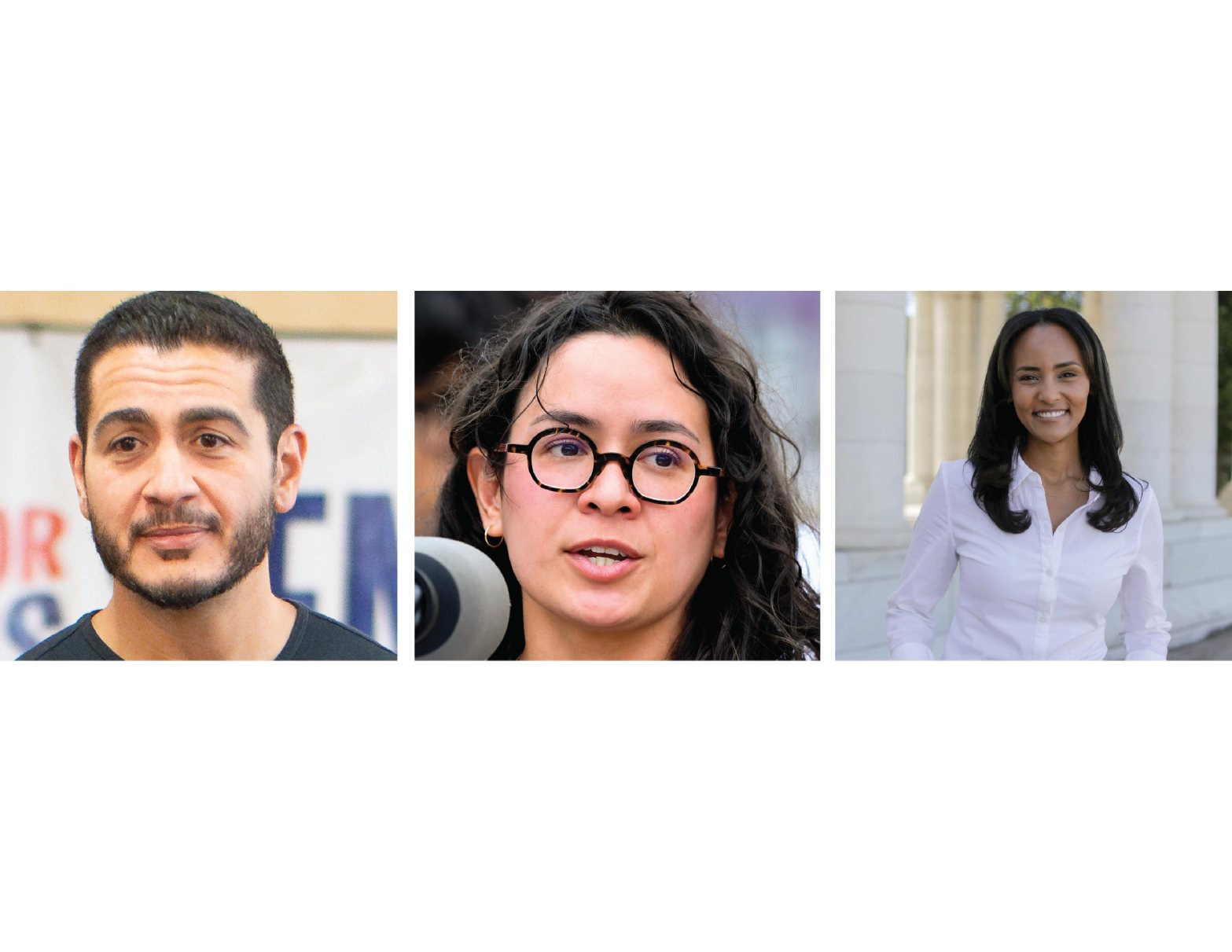
Several members of the Democratic Socialists of America (DSA) and DSA-backed candidates had high-profile wins in Democratic Party primaries ahead of this year’s midterms. These campaigns are running on progressive demands like Medicare-for-all and as anti-ICE, anti-genocide candidates. NYC DSA members Claire Valdez and Darializa Avila Chevalier were vocally pro-Palestinian, as were Melat Kiros in Colorado and Abdul El-Sayed in Michigan.
As Trump’s approval ratings drop to an all-time low (33%), and as support for the Democratic Party has in the last year soured to its lowest point in 35 years as well (also at 33%), the DSA-driven “progressive” campaigns direct the fight against Trump and the cost-of-living crisis to reforming the Democratic Party, or trying to move it to the left.
Big money has already been thrown against these campaigns. $70 million was spent trying to defeat Abdul El-Sayed (a non-DSA Democrat and self-proclaimed capitalist), and over $30 million of that by the American Israel Public Affairs Committee (AIPAC) alone. Since his win, the think tank Third Way announced plans to spend $15 million to “discredit democratic socialism.” Tech, AI, and online gaming companies have put $294 million toward campaigns so far, and AIPAC $67+ million. Elon Musk alone plans to spend $90+ million. The current total spent on Congressional elections – $517+ million – far surpasses that of the 2024 elections, which totaled $461 million. All political spending this election cycle is expected to reach a record $11.6 billion, above 2024’s record-breaking $11.4 billion.
Despite both wins and losses, DSA and DSA-backed candidates are reassuring the Democratic Party that at the end of the day, their goal is to keep the party united. In the Wisconsin race for governor, Francesca Hong, despite a narrow loss to David Crowley by 0.5%, swiftly backed her opponent: “I fully support him and look forward to working with him to defeat [Republican] Congressman Tiffany in November.” El-Sayed: “We all have the same goal, which is to defeat Mike Rogers…Whatever our differences around how the Democratic Party should look…we do know that we have to beat Trump, we do know that we have to take back the Senate…and I’m looking forward to figuring out how to work together to make that happen.” DSA member Oliver Larkin, in discussing how voters will have to register as Democrats to participate in the Florida primaries: “This is DSA broadening the tent and bringing people into the fold.” Chevalier, even on the campaign trail, said of whether she voted for Biden in 2020 despite her criticisms of him: “I still took one for the team and voted.”
In an interview on “This Week,” Alexandria Ocasio-Cortez said: “I think that we are in a time of renewal for the Democratic Party….I think that this really is a moment, not just in Michigan, but across the country, where the party is unifying…..Democrats have a responsibility to build a winning coalition.” (8/9/2026)
But where should we expect these primary wins to go, and what will they achieve?
The Feedback Loop of “Reforming the Democratic Party”
When Alexandria Ocasio-Cortez first won her House Representative seat in 2018, she campaigned on Medicare-for-all, abolishing ICE, and universal paid family and sick leave. Eight years on, none of this has been achieved.
9 years ago, Medicare for All had 62% support. Today, support for public universal healthcare is even greater, at 66%. AOC wasn’t a lone wolf back in 2018: other Democrats like Katie Porter and Kara Eastman also won elections demanding Medicare-for-all. Even Hakeem Jeffries expressed support for Medicare-for-all back in 2019. In August, Hakeem Jeffries voiced his opposition to Medicare for all, and leading DSA Democrat Alexandria Ocasio-Cortez reacted to the primary wins with “Woke 1 was crazy.” Jeffries even met with Trump’s son-in-law Jared Kushner to discuss points of common ground.
It hasn’t been only on healthcare that AOC and the Democratic Party haven’t delivered. Despite standing for “an economy of peace” back in 2018, AOC voted in 2025 for funding the Iron Dome and, in 2024, campaigned for Biden and Harris, insisting Harris was “working tirelessly” for a ceasefire in Gaza.
AOC is not an anomaly. NYC Mayor Zohran Mamdani, also a DSA Democrat, campaigned on freezing the rent, making buses free, and making childcare free. Yet since winning 2025’s city election, the new Mamdani administration is privatizing public housing through the Rental Assistance Demonstration (RAD) and Permanent Affordability Commitment Together (PACT) programs. He iced out public housing residents from the city’s “rental ripoff” hearings – and for good reason. Despite $78+ billion in needed repairs for public housing across the city’s 2,500 buildings, the city recently decided to allocate only $5.6 billion over the next 5 years. The administration’s NYC Housing Authority (NYCHA) also announced plans to raze the 2,055 public housing units in Manhattan’s Chelsea neighborhood and replace them with 2,500 market-rate units and 1,000 units of Section 8 private housing, jeopardizing residents’ housing security.
After City Council voted to give paraprofessionals a one-time $10,000 increase to their pay, which starts at $32,600/year, Mamdani – who had previously supported a bill that gave paras even higher pay – is now suing against the move. Meanwhile, the city faces 1,600 paraprofessional vacancies.
Despite a campaign promise of $65 million for trans healthcare, Mamdani allowed the gutting of millions in funding for trans healthcare in the most recent city budget. After NYU Langone and Mount Sinai both ended trans healthcare services for youth back in February under threats from the Trump administration, Mamdani’s planned direct-care trans health clinic announced it, too, does not plan to provide care to those under 19.
Soon after being elected, Mamdani said his goal was “to win people back to the Democratic Party.” and followed that with endorsements for Hakeem Jeffries and Governor Kathy Hochul. He even warded off an attempt by DSA member Chi Ossé to run against Jeffries. He kept on former mayor Eric Adams’ police commissioner Jessica Tisch, who led the attacks and arrests against pro-Palestinian protestors on college campuses and has continued to deploy officers against anti-ICE protestors, anti-genocide activists, and striking nurses.
Both AOC and Mamdani’s records encapsulate the DSA’s approach to elections: campaign in the Democratic Party on a progressive platform, but once in office, shift rightward to appease opponents in the party and to keep the party united by enacting “reasonable” policies like cutting public services, giving handouts to corporations and the rich, and funding imperialist wars and genocide. What has this strategy delivered to working-class people? And where do we need to take the fight for universal healthcare, a $30/hr minimum wage, a rent freeze, free childcare, etc., if the Democratic Party has proved a dead end?
The question of independent politics comes around every election cycle, but gets undermined time and again as union bureaucrats, nonprofit NGOs, and the majority of the US left continue to push “vote blue no matter who.” Upton Sinclair’s End Poverty in California (EPIC) campaign, which aimed to address the needs of working people suffering during the Great Depression, including the 700,000 unemployed in the state, was driven into his 1934 Democratic Party run for governor. The campaign failed, and EPIC, which had organized 800 local clubs in support of the public takeover of farms and factories to provide jobs for all, dissolved.
Union members who voted to form a Labor Party in the 1930s and 1940s were undermined by union leadership and members of the Communist Party who blocked these efforts and pushed support for Franklin Delano Roosevelt. These traitors to labor formed the American Labor Party and the Labor’s Non-Partisan League (LNPL) as sly ways to still back the Democratic Party, the LNPL even raising $1.5 million for Roosevelt’s 1936 presidential run.
A Working-Class in Need of Our Own Party
Many signs point to the promising potential of building outside both the Democratic and Republican parties through a new independent working-class party. For one, 62% think both parties “do such a poor job that a third major party is needed.” This support for a third party has been consistently around 60% for the last 13 years since 2013. A record-high 45% are now registered as independents. 65% support Medicare for All, and 75% are opposed to AI data centers being built in their backyards. A majority approve of government price controls. 65% want an end to the war on Iran. And in the 2024 presidential elections, neither of the two corporate political parties could convince 36% of those eligible to vote to bother coming to the polls.
There is and has been significant support for independent politics in the US. The Socialist Party, which reached a peak membership of 113,000 in 1912, won over 1,000 seats in 353 cities and towns across the country. Socialist Party member Eugene Debs’ 1912 and 1920 presidential runs won nearly 1,000,000 votes each. The recent independent, openly “revolutionary socialist” Kshama Sawant campaign for Senate won 17% of the vote in the Washington primaries. Sawant’s election to Seattle City Council in 2013 as an independent, openly socialist candidate helped win the first $15/hr minimum wage in the country through amplifying the 15Now campaign.
In a significant contrast to the national DSA’s electoral strategy, the Rhode Island chapter of the DSA is running one of its members as an Independent Socialist for the RI State House. The Brittany for RI campaign stands for a rent freeze, a $30/hr minimum wage, affordable publicly owned housing, and public takeover of utilities. Its campaign material states “We Need a Party for the Working Class.”
Following its own experiences running members as Democrats whom it failed to hold accountable (most notably David Morales, who’s currently running as a Democrat for mayor of Providence), RI DSA voted in 2023 to end support for the Democratic Party and run only independent campaigns. In its 2023 electoral resolution, it states:
“Both Democrats and Republicans pass laws to protect corporations while we struggle to afford housing, medical care, and basic necessities…The Rhode Island chapter of the Democratic Socialists of America is building an alternative to the two-party status quo.”
Independent Socialist Group voted to endorse the Brittany for RI campaign this year and are actively supporting the campaign through canvassing and joining RI DSA’s efforts to build a workers’ party. We also voted to endorse the Andrea James independent left campaign for Massachusetts governor that supports rent control, a $25/hr minimum wage, and free higher ed for all.
Unfortunately, many of these independent electoral efforts are actively undermined by the two corporate parties. “Jungle primaries,” such as those in Washington and California, where only the top two candidates move on to the general election, serve to block out independent candidates who lack the resources to compete with the two corporate-backed parties. High thresholds to qualify to get onto the ballot – such as the 10,000 signatures needed to run for Massachusetts governor – also make it hard for independent working-class campaigns that lack resources. And the Democratic Party is more than willing to make up legal challenges to block candidates as well, such as in the case of 2024 Green Party Vice Presidential candidate Butch Ware’s run for California governor this year, where he was prevented from being listed in the primaries.
Working-class people need a new political party that fights for our interests. A political party independent of the billionaires and their two corporate parties and funded by the working class. Unions have $32+ billion in net assets that could be used to help build a workers’ party. A workers’ party could fight for higher pay, massive tax increases on corporations and the rich, universal healthcare, a $30/hr min wage, and paid sick and parental leave. A workers’ party could be organizing mass protests, occupations, and help expand strikes to stop ICE and oppose US funding of Israel’s genocide.
There’s a price paid for “vote blue no matter who,” for each time working people fail to understand that the Democratic Party is a dead end and that we need our own political representation and expression. That lesson is paid for in the blood of those killed in wars, climate catastrophes, and ICE prisons; in the needless deaths from lack of healthcare, food, sick time, and safe working conditions; in the struggles of those living off poverty wages in housing they can’t afford, who face the very real chance that they might lose their jobs or be thrown out onto the streets.
“We are not here to play the filthy game of capitalist politics. There is the same relative difference between capitalist class politics and working class politics that there is between capitalism and Socialism.”
– Eugene Debs, presidential campaign speech “This is Our Year: But Two Parties And But One Issue” (1912)

