
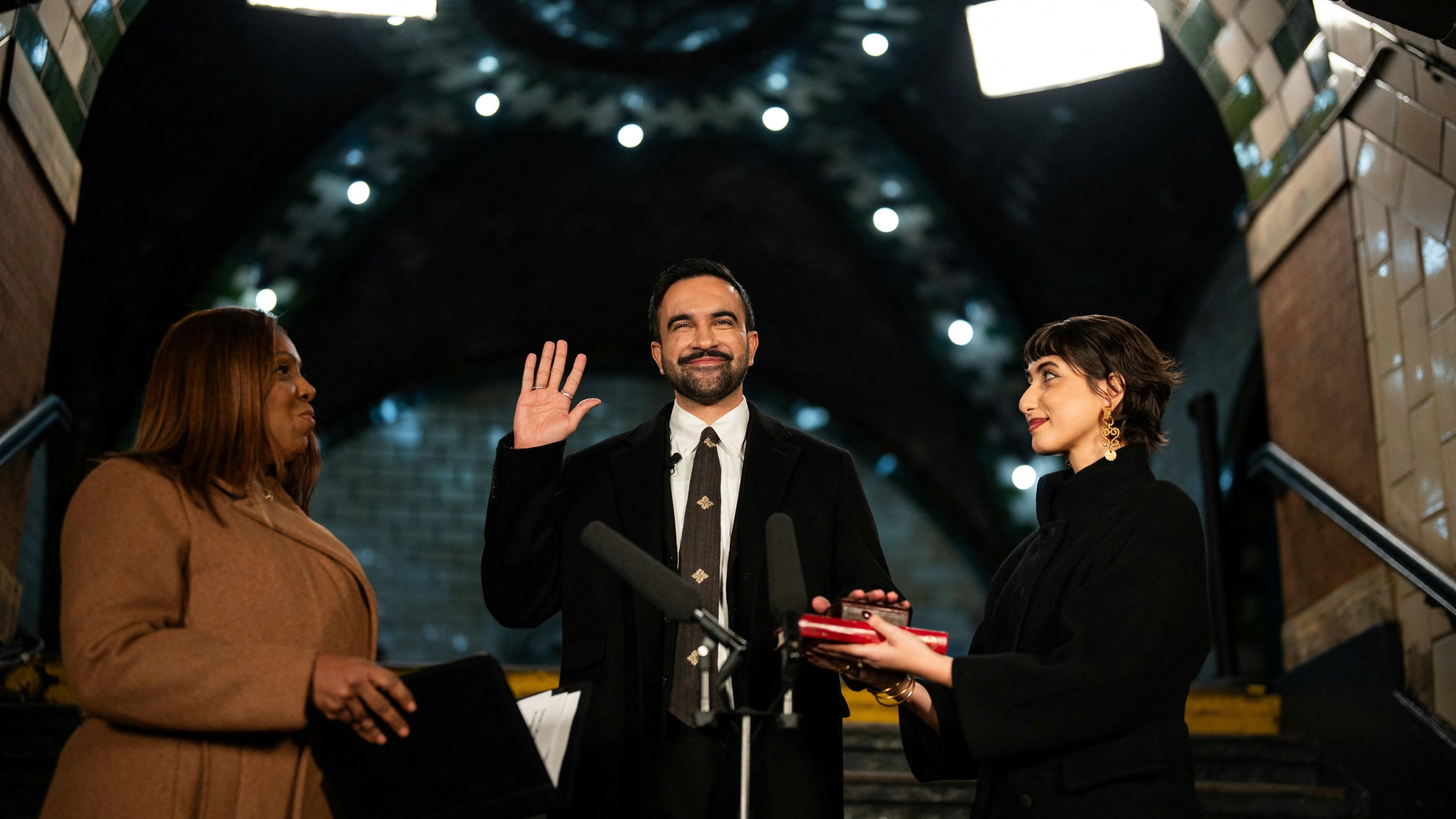
Winning the Demands of the Mamdani Campaign
Jeff Booth, AFSCME Local 3650 (personal capacity)
“A great New Yorker once said that while you campaign in poetry, you govern in prose.”– From Zohran Mamdani’s victory speech, quoting Mario Cuomo, a former Democratic Party Governor of New York State.
“Socialist reform must not be confounded with so-called capitalist reform. The latter is shrewdly designed to buttress capitalism; the former to overthrow it. Socialist reform vitalizes and promotes the socialist revolution.” –Eugene Debs in a campaign speech as Socialist Party candidate for president in 1912.
Zohran Mamdani, a self-described “democratic socialist” and now mayor of New York City faces a choice: responsible “governance” of NYC or responsibility to the struggles of the working class. Mamdani’s win in the race for mayor is a reflection of developing class war in the U.S., including the inevitable fight over money, land, jobs, and real political power to win even minimal reforms for working people.
New York City is the financial epicenter of the billionaire and multi-millionaire capitalist owners who are using and abusing workers’ labor, the environment, and basic human needs like housing, food, childcare, education, etc. to grab record levels of profit while the rest of us contend with declining living standards, massive inequality, and increasingly precarious futures.
NYC has the largest number of billionaires in the world: 123, who hold a combined net worth of $759 billion.
“Under the status quo minimum wage policy in New York City, we project there will be 1.68 million workers earning less than $30 in 2030, a little more than a third (36.7%) of the total wage-earning workforce in the city.” [Economic Policy Institute, 8/28/2025]
According to the Gothamist, which wrote the following based on a recent report by The New School’s Center for New York City Affairs:
“The wealthiest New Yorkers, those with an average household income above $517,700, will experience an after-tax income gain of $13,600 due to the sweeping domestic policy bill Trump pushed through Congress in 2025. At the same time, those at the other end of the income scale, with an average household income of $38,840, will experience an after-tax income loss of $1,200, according to the analysis.
“Those changes are taking place in a city whose residents, on the whole, are struggling. Real median household income in New York City declined by 4.9% from 2019 to 2024, while it has increased nationally by 0.9%, according to the report. Among the top-10 largest cities, no other city experienced a statistically significant decline in its median household income during the same period, according to the center.
“‘The combination of declining real median income, increasing wages at the top of the income distribution, and high cost-of-living pressures has resulted in growing precarity among low and middle-income households in New York City,’ the report states. …
“Federal health care cuts enacted in 2025 will increase costs and place many New Yorkers at risk of losing insurance, including about 350,000 low-income city residents who are at immediate risk of losing coverage through the state’s Essential Plan. …Another blow comes in March, when as many as 230,000 New Yorkers are set to lose access to food stamps due to revisions in federal SNAP eligibility, the report notes. Tax cuts, similarly pushed through by President Donald Trump and the Republican-led Congress, will transfer billions of dollars in wealth from low-income New Yorkers to high-wage earners, the report states.”
The “affordability” crisis highlighted by the Mamdani campaign grinds on despite the election win. The word “affordability” seems too mild for the capitalists’ massive theft of value created by the working class in NYC and throughout the U.S. For many working-class people, even in a wealth-encrusted city like New York, it’s really a “survivability” crisis.
A recent essay in Counterpunch reports that nationwide, 19 households, or .00001 percent of the population, held $2.6 trillion of the nation’s total wealth in 2024 and within the past year that has increased to over $3 trillion…“Those 19 households in our top .00001 percent comprise 5 percent of America’s top .0002 percent (380 households, or roughly, the Forbes 400). Their share of the wealth of that larger group of billionaires now stands at about 50 percent today, a quadrupling since 1982.”
“What a year for the ultra wealthy. The world’s 500 richest people added a record $2.2 trillion to their collective fortunes in 2025, as booming markets sent the value of their holdings soaring, according to the Bloomberg Billionaires Index. And about a quarter of this year’s gains went to just eight billionaires.” [Bloomberg, 12/31/2025]
This is what we’re up against, in New York City and around the U.S. And whether it’s billions or trillions, it’s never enough for the capitalists because it’s their ownership of production, land, and distribution through big corporations that keeps the money flowing and their control over the political process, their two corporate parties, and the capitalist state.
Mamdani’s quote about billionaires during his campaign got a lot of attention in the corporate media. On NBC News’ corporate media show “Meet the Press,” he said: “I don’t think that we should have billionaires because, frankly, it is so much money in a moment of such inequality, and ultimately, what we need more of is equality across our city and across our state and across our country.” This is all true, good, and any socialist worth the name would agree.
However, he followed up with: “And I look forward to working with everyone, including billionaires, to make a city that is fair for all of them.” Just about every working class person reading this would be like, “wait a minute, money, especially big money, comes with strings attached.” And hopefully most socialists would add that we don’t want to work with billionaires, we want to fight against their ownership of what is really social production and public lands and the political power they corrupt and control.
The tension inherent in Mamdani’s quotes above about billionaires is at the heart of the problem in his, and the DSA leadership’s, approach to electoral politics. They’re not understanding class contradictions, not running outside the corporate duopoly of the Democratic and Republican Parties, and not preparing a militant strategy to win the reforms working people need immediately, all of which they should be doing while simultaneously building independent working-class politics as part of the fight for socialism.
The new Democratic Party Mayor of NYC and the administration he’s constructing can try to win the “affordability” program he campaigned for by managing capitalism more efficiently, trying to not piss off Trump, trying to charm the billionaires, the multi-millionaires, and the corporate media, trying to help keep the Democratic Party power structure sputtering along with their millionaire and billionaire donors unoffended. This is a method that will win praise for “realism” and “responsible governance” from the ruling class and their corporate media, but it won’t win significant reforms for the working class, it won’t even begin to solve the chronic problems working people face, and it certainly won’t build a socialist movement.
Mamdani and DSA leaders can choose instead to break with Democratic Party corporate politics and help build a mass working-class movement and organization to win demands raised in Mamdani’s election campaign for mayor. The massive amounts of time and money being wasted in the wake of the election victory to build a “transition team” of Democratic Party operatives and career-oriented professionals could instead be spent on extending the activist base from the electoral campaign. Organizing new, wider, and deeper layers of working-class support was more important than a transition team and inauguration ceremonies. Right after the election, the time was ripe for jump-starting the mobilization of a grassroots campaign for a $30/hr minimum wage, extending free universal childcare, free buses, and a huge, desperately-needed mass building of city-owned public housing with union labor. To really win these demands and others in the program he ran on, it will take moving from rhetoric to mass action.
Instead of accepting the boundaries of corporate politics, Mamdani and DSA leaders could help organize a New York-sized working-class army of activists and supporters from the election campaign as well as organize other progressives, union members, community and anti-ICE activists, socialists, and many more working and young people. A mass campaign and organization based on key demands from the campaign could engage tens of thousands in protests, strikes, occupations, school walkouts, and other actions.
A PATTERN OF ACCOMMODATION AND DEMOCRATIC PARTY MANEUVERING
In the wake of Mamdani’s election victory, there have been signs that a fighting strategy for winning the campaign’s main demands is not being taken up by Mamdani or the DSA leadership. Between Election Day (November 5th) and Inauguration Day (January 1st), valuable time and resources were not used on organizing and mobilizing the base of activists and supporters from the campaign into building a movement and mass organization around key demands from the campaign. Instead, there were moves that fell in line with what’s acceptable to the billionaires and the Democratic Party.
The day after the election, Mamdani named five Democratic Party politicians to his “Transition Team.” All of them had been part of previous pro-corporate Democratic Party administrations:
- Elana Leopold, a top aide to de Blasio, former Democratic Party mayor of NYC.
- Maria Torres-Springer, who held high positions in the neo-liberal trifecta of the de Blasio, Bloomberg, and Adams administrations.
- Lina Khan, chair of the Biden administration’s Federal Trade Commission.
- Grace Bonilla, a co-chair of the Biden Federal Trade Commission, CEO of The United Way of New York City, also held positions under various directorships in the de Blasio and Mayor Bloomberg regimes.
- Melanie Hartzog, who under the de Blasio administration was New York City Budget Director and Deputy Mayor for Health and Human Services.
Mamdani also appointed a First Deputy Mayor, Dean Fuleihan, a Democratic Party functionary and operative for over half a century in the New York State Assembly and in New York City government. He delivered austerity policies for the capitalist class as a Chief Fiscal and Policy Advisor and Budget Analyst, among other lucrative posts. More recently he was de Blasio’s Director of the Office of Management and Budget and First Deputy Mayor, during which he helped implement attacks on unionized teachers’ pay and healthcare coverage. Democratic Party Governor Katherine Hochul appointed Fuleihan to the New York State Financial Control Board. Hochul, who has stated she is against raising taxes on the rich, is by all accounts pleased at Mamdani’s choice for First Deputy Mayor.
On November 19th, Mamdani announced that he had asked Jessica Tisch, who was appointed by the previous mayor, Adams, to remain as the New York City Police Department Commissioner. Tisch accepted. She’s from a billionaire family with at least $10 billion in their treasure-hoard, the 43rd richest family in the U.S., owning the New York Giants and the Loews Corporation. Politically, Tisch supports the Israeli State and oversaw police attacks on pro-Palestinian student activists and protestors on campuses and in the streets. She’s in favor of expanding the number of NYC cops, already at over 36,000, the largest municipal police force in the world. New York City legal services workers in ALAA-UAW Local 2325 released a statement on December 19th, 2025, opposing Mamdani’s appointment of Tisch. Here is an excerpt of the union’s statement, “A Resolution to Drop Jessica Tisch,” adopted by a union membership vote:
“…Through the NYC Police Foundation, the Tisch empire has bankrolled the department’s propaganda infrastructure, international operations, and surveillance technology, underwriting a police force that shields the wealthy while punishing the poor. She wields the NYPD to serve her class at the direct expense of ours.
Her alignment with Israeli state violence is consistent with this same project of repression. Tisch has praised, trained alongside, and welcomed officials responsible for the genocide in Palestine. Earlier this year, NYPD trainings under her watch labeled keffiyehs and even watermelons as “antisemitic symbols,” turning Palestinian cultural expression into something to be policed. Her pledge to the ADL to bring down the force of the NYPD upon New Yorkers who protest Israel makes her unfit to lead any agency that claims to serve a multiracial, immigrant city.
Throughout her tenure, Tisch has expanded the NYPD’s power and reach — from reviving Broken Windows enforcement to deepening the city’s surveillance dragnet through the Domain Awareness System, a multibillion-dollar fusion of cameras, license plate readers, biometric data, and social-media monitoring. Reappointing her guarantees the continuation of an NYPD defined by violent protest crackdowns, aggressive crowd-control tactics, and protection for ICE as it terrorizes immigrant New Yorkers. …ALAA-UAW Local 2325, the union of over 3,500 New York City legal services workers, urges Mayor-elect Mamdani to drop Tisch immediately. A city committed to justice cannot be built on the foundations of repression, occupation, and billionaire police power.”
Mamdani had called the NYPD “racist, anti-queer, and a major threat to public safety.” He also supported defunding the police in 2020. But during his campaign for Mayor, Mamdani repeatedly walked back his previous statements. Mamdani should stand by what he said. He should rescind his recent appointment of Jessica Tisch as Police Commissioner.
These appointments, and many others, indicate a Democratic Party, business-as-usual approach to city government. Appointing corporate politicians with years of complicity in making New York City unaffordable runs counter to the Mamdani campaign goals, sets up internal barriers to any real attempts to win significant demands for working people, and also favors an inside, backroom strategy of deal-making while sidelining any attempt to build a militant, mass movement which will be necessary to really improve the lives of the working class and help organize independent working-class, socialist politics.
Continuing his busy November, Mamdani took time to attend a DSA meeting in Manhattan on November 19th to argue against NYC DSA endorsing Chi Ossé‘s attempt to win the endorsement of DSA to run a Democratic Party primary campaign against Hakeem Jeffries. On November 23rd, Mamdani endorsed Jeffries on Meet the Press. Hakeem Jeffries is the most powerful Democrat in the House of Representatives. He’s heavily supported by the American Israel Public Affairs Committee (AIPAC). He’s an apologist for Israeli state genocidal policies in Gaza and criticized by pro-Palestinian, peace, and left groups for his political complicity with the genocide in Gaza. While Mamdani is a member of DSA and supported by DSA, Jeffries is known for campaigning against DSA candidates in New York. Jeffries also signed onto and voted for a House of Representatives bill condemning socialism. Why would Mamdani support this politician? Even within the corporate confines of the Democratic Party that Mamdani embraces, Jeffries is not a “progressive” or a DSA Democrat.
AND THEN THERE’S THAT VISIT WITH TRUMP…
On November 17th, Mamdani contacted the Trump administration, requesting a meeting with Trump. Four days later on the 21st, he met with Trump in the White House. Given how quickly the meeting happened, it must have been a high priority for both Trump and Mamdani.
Mamdani defended his turn to Trump in terms of helping New Yorkers with assistance from Trump in dealing with the affordability crisis most people in NYC are experiencing. While many liberals and DSA “socialists” defended Mamdani’s Trump maneuver, it was an indefensible move. Mamdani’s meeting with Trump and the press conference afterwards served to legitimize Trump as worthy of respect and a billionaire politician who “cares” about affordability and the people of New York. Trump is not at all concerned about “affordability” issues in NYC. Trump and his class, the capitalist class, are responsible for the affordability crisis in NYC. Trump made hundreds of millions of dollars through real estate deals that were and are a big part of gentrification and the housing crisis in New York. Trump and his billionaire cohort are only interested in exploiting New Yorkers and workers in general. Trump played Mamdani, not the other way around.
Here’s some of the Trump/Mamdani exchange at their press conference:
Trump: “But I just want to congratulate. I think, hopefully, you’ll have a really great mayor. The better he does, the happier I am. There is no difference in party. There is no difference in anything, and we’re going to be helping him to make everybody’s dream come true. Having a strong and very safe New York, and congratulations, Mr. Mayor.”
Mamdani: “Thank you, Mr. President.”
Trump: “Thank you.”
Mamdani: “I appreciate it.”
Trump: “Please.”
Mamdani: “I appreciated the meeting with the president, and as he said, it was a productive meeting focused on a place of shared admiration and love, which is New York City. And the need to deliver affordability to New Yorkers, the eight and a half million people who call our city their home, who are struggling to afford life in the most expensive city in the United States of America. …I’m really looking forward to delivering for New Yorkers in partnership with the president on the affordability agenda.”
…Reporter: “I want to ask the mayor-elect about a House resolution, just passed overwhelmingly, to condemn socialism — including with 86 Democrats, all of House Dem leadership and the minority leader, Hakeem Jeffries, despite his endorsement of you. What’s your reaction to that?”
Mamdani: “I have to be honest with you, I focus very little on resolutions. Frankly, I’ve been focusing —”
Reporter: “It’s against socialism.”
Mamdani: “I understand. I think that the focus is on the work at hand. I can tell you, I am someone who is a democratic socialist, I have been very open about that. And I know that there might be differences about ideology, but the place of agreement is the work that needs to be done to make New York City affordable. That’s what I look forward to.”
Mamdani’s orientation to Trump is a misdirection of political effort. While ICE rampaged in the streets of New York, Mamdani meets with Trump? Any promises or hints of better treatment from the Trump administration for New York is coming from a politician and regime infamous for lying and for chaotic changes in policies from one day to the next. The Trump visit was not only useless, it was also a betrayal to Mamdani’s supporters, and mocks the pro-Palestinian, anti-genocide, and anti-imperialist movements. Federal union workers who’ve been laid off or fired must have really enjoyed seeing Mamdani smiling along with Trump. Activists in the struggle for LGBTQ rights must be thrilled with Mamdani’s new-found friend. Working people who have lost their SNAP/food stamp benefits must have really appreciated the spectacle of a self-described “democratic socialist” chatting about “affordability” with the billionaire who initiated major cuts in SNAP/food stamp benefits.
If any of the most serious demands of the Mamdani campaign are really fought for, Trump will drop the pretense and go on the attack along with the rest of the billionaires and their class. It’s wrong for Mamdani and anyone who defends his meeting with Trump to spread illusions in appeasing an authoritarian, billionaire capitalist president who leads police forces like ICE, the Department of Homeland Security, the FBI, etc. that are already in the streets of NYC repressing and hurting many New Yorkers. Trump’s regime is also directing and doing the dirty work of many of the economic forces that will viciously and violently oppose any real reforms for the working class in NYC.
In the press conference, Trump said “there is no difference in party.” Mamdani’s whole approach to Trump emphasizes bipartisanship and minimizes ideology. But ideology includes how people and organizations perceive and analyze events and what they think are acceptable political actions in response.
Mamdani invoked Eugene Debs in his victory speech after winning the mayoral election. Debs was the most prominent leader of the Socialist Party in the U.S. in the early 20th century. The Socialist Party was anti-capitalist and totally independent of and opposed to the capitalist class and the two corporate parties, the Republicans and Democrats. In the wake of the Trump/Mamdani meeting and joint press conference, it’s worth remembering a few things Debs had to say when running for president in 1912 that are still relevant now, especially to anyone who is or claims to be some sort of socialist:
“We are not here to play the filthy game of capitalist politics. There is the same relative difference between capitalist class politics and working class politics that there is between capitalism and Socialism. …We are today entering upon a national campaign of the profoundest interest to the working class and the country. …There is no longer even the pretense of difference between the so-called Republican and Democratic parties. They are substantially one in what they stand for. They are opposed to each other on no question of principle but purely in a contest for the spoils of office. To the workers of the country these two parties in name are one in fact. They, or rather it, stands for capitalism, for the private ownership of the means of subsistence, for the exploitation of the workers, and for wage-slavery. Both of these old capitalist class machines are going to pieces. Having outlived their time they have become corrupt and worse than useless and now present a spectacle of political degeneracy. …The evolution of the forces underlying them is tearing them from their foundations and sweeping them to inevitable destruction.”
OUT OF THE BOARDROOMS AND GOVERNMENT OFFICES AND INTO THE STREETS
An opportunity was missed in the Mamdani campaign, even as the decision was taken to run for mayor. A socialist approach to an electoral campaign would not rely on getting elected first, and then trying to deliver on important reforms once in office. Especially since at this point in history, when taking office, there will most likely be a pro-capitalist city hall, state legislature, Congress, courts, president, etc. and of course the men behind the curtain: the billionaires and their money buying the politicians of the duopoly parties and funding the corporate media.
For a socialist, the decision to run for office should not rely on promises to act after getting elected, but instead an election campaign should initiate and/or actively help to build a movement around a key demand or a few key demands and then use the run for office to help build the movement in support of the demands. For example: campaigning on a specific increase in the minimum wage in a city or state or even nation-wide, and then centering the campaign for political office on amplifying and organizing for the demand before, during, and after running for office. Using this method, there’s a growing mass movement to win the main issue or key demands of the campaign whether or not an individual gets elected. If an electoral campaign is built on and enhances a movement for key demands and ends up winning, then there’s already organization in place to pressure the corporate parties after the election to win the demand. If the campaign loses, there’s still the potential to use that momentum to continue organizing both inside and outside electoral campaigns. A victory on one demand can quickly lead to other victories and organization for new electoral campaigns.
There are examples of progressive and socialist independents who’ve run for political office based on this method. A recent example is the 15Now effort in Seattle, Washington, where in 2013-2014, an already existing campaign for a $15/hr minimum involving unions, left groups, and progressive community organizations played a major role in the decision by Socialist Alternative and Kshama Sawant to run as an open socialist for Seattle City Council after being heavily involved in building the 15Now campaign. The campaign then made 15Now the main issue in the run for city council, which in turn helped make both the electoral campaign and the 15Now movement better known and stronger. After winning the election in 2013, the growing support and strength of the 15Now movement combined with a revolutionary socialist elected to the city council and the use of militant tactics all put enormous political pressure on the Democrats dominating the city council. The $15 minimum wage passed in 2014, despite the best efforts of the Democratic Party to weaken or stop it. Seattle still has the highest minimum wage of any city in the country at $21.30, with annual adjustments for inflation.
Although there’s been activism in New York City around a higher minimum wage, universal childcare, housing, etc. it didn’t coalesce into a mass movement, and Mamdani’s campaign was not based on building a coherent, strong mass movement around one or more of these issues prior to or during the campaign for mayor. Instead, campaign promises focused on getting elected and then taking a legislative, “good governance” approach as mayor, relying on somehow convincing the Governor and State Assembly (Legislature) to deliver on the demands in the future. Mamdani ran for mayor as a Democrat and before that represented the Democratic Party in the New York State Assembly for five years, 2021-2025. His entire political career has been enmeshed with the Democratic Party. Prior to holding the state legislator position, he was involved with Democratic Party campaigns in NYC, including as paid campaign staff and a campaign manager for a 2018 New York State Senate campaign by Ross Barkan. Mamdani is used to the Democratic Party’s internal machinations and external propaganda via the corporate media. However, to win even the relatively modest but important demands of his mayoral campaign, Mamdani and DSA leaders should see the Democratic Party as an obstacle, not a vehicle for winning any significant demands for the working class.
A NEW YEAR, A NEW FIGHT
There is still the opportunity to use the activity and heightened expectations from the mayoral campaign, victory, and the inaugural celebration to take a new approach to fighting for real improvements to living standards for the majority of New Yorkers and to help build an independent mass movement of working-class people. Failure to do so will bury that activist energy and hope in the dead end of the Democratic Party.
Mamdani’s election campaign attracted many new voters based on the perception and hope that Mamdani as mayor was going to mean much more than business as usual. In the wake of the election victory, there were signs that a fighting strategy for winning the main campaign demands is not the direction being taken by Mamdani or the DSA leadership. The massive amounts of time and money being wasted to build a “transition team” of Democratic Party operatives and career-oriented professionals could instead be spent on extending the activist base from the electoral campaign into organizing new, wider, and deeper layers of working-class support and mobilization around a post-electoral, grassroots campaign for a $30/hr minimum wage, extending free universal childcare, free buses, mass building of public housing with union labor, and significant tax increases on the corporations and the rich.
Standing in the way of winning demands raised in Mamdani’s election campaign is not just the capitalist class, the Trump regime’s police state methods, the billionaires and their corporate media. There’s also the Democratic Party itself–the political party Mamdani has chosen for his political career. Both conservatives and liberals are already propagandizing that many of the important reforms from the campaign are “impossible” without the approval of the Democratic Party-controlled New York City Council, Governor’s office, State Legislature, and city and state bureaucracies.
The economic and political crisis facing the working class demands a new approach, not just the rhetoric and perception of something new. If enough political pressure is organized, none of the capitalist parties or institutions will be able to stop reforms from being won.
A FIGHTING STRATEGY, PROGRAM, AND ORGANIZATION FOR THE WORKING CLASS IN NYC
Strategy, program, and organization are interconnected.The overall strategy for achieving the demands raised in Mamdani’s campaign in any real way will involve building a mass movement and organization independent of the Democratic Party, including the Mamdani administration.
If Mamdani and DSA leaders support the strategy, organization and specific tactics it will take to win the demands of the campaign, and more, then they could play an important role in building the necessary militant class struggle based on working people and youth in the streets, workplaces, neighborhoods, and schools to win the “affordability” program. But that would also mean supporting mass protests, strike action, occupations, school walkouts, and other tactics that will meet the class struggle moment in NYC and around the U.S.
Building this kind of movement means mass organizing that moves way beyond the NGO lobbyist model of “Our Time for an Affordable New York City,” an organization set up by some DSA members in NYC to support Mamdani. Already “Our Time” is saying “send a letter to your representatives demanding universal childcare.” This begs two questions: 1) who are “our representatives?” Neither corporate political party represents the working class and 2) When has writing a letter ever done anything in terms of winning mass social benefits?
ASSEMBLIES OF WORKING PEOPLE TO WIN HOUSING, A $30/HOUR MINIMUM WAGE, UNIVERSAL CHILDCARE, TAXING THE RICH AND THE CORPORATIONS
There’s an alternative to non-profit single-issue pressure groups using a standard Non-Governmental Organization (NGO) model tailing the Democratic Party. Members of DSA, Mamdani supporters from the campaign, union activists and members, tenants unions, socialists, progressives, pro-Palestinian protestors, etc. can look beyond lobbying the Democrats and symbolic protests. These organizations could be part of organizing open assemblies, essentially open mass meetings in neighborhoods, schools, community centers, common areas in apartment buildings, parks–wherever people can gather. Assemblies should not just be talk shops, but should include structured, chaired discussions and voting that will result in actions that will build a mass movement for key demands:
Housing: Instead of “affordable housing,” which usually means a few low-rent apartments in a cluster of high-rent apartments and tying housing needs to private contractors and real estate corporations, we need a mass movement in support of a public works program with union membership and union working conditions to build a record-breaking amount of public housing that would be owned and maintained by the city through democratically-elected public housing boards. Militant, mass tactics including identifying and occupying abandoned or underutilized properties and taking them by eminent domain would be needed to make this a real movement.
A $30/hr minimum wage: We should start with acknowledging that the $30/hr minimum wage demand in Mamdani’s platform is being minimized, intentionally ignored post-campaign, by both the corporate media, much of the alternative media, and by Mamdani himself for the most part. It may get mentioned here or there, but it should be front and center. It’s a unifying demand and one that, if a serious movement is built focused primarily on this, could energize and help mobilize young people and workers in a way no other demand in the affordability program would be able to. If successful, or even partially successful, it could raise the base wage floor in NYC for everyone. It doesn’t help to raise this demand in increments or to put it off for years, like “30 by 30,” as was done in the mayoral campaign. We can win 30Now if organization and tactics are used that go beyond what’s acceptable to Democratic Party politicians and liberal NGO directors.
Free Universal Childcare: This demand from Mamdani’s campaign for free universal childcare from six weeks to five years old is long overdue. The duopoly, the ruling class, the billionaires have been saying it’s too expensive, that it would cost billions. $6 billion per year is tossed around by the corporate media as a scary number. But the money is there, and they know it. New York State’s annual budget for fiscal year 2025-2026 is $254 billion. The New York City budget, separate from the state budget, for fiscal year 2025 was $112 billion. It’s a question of priorities, and the billionaires and the Democratic and Republican parties do not care about working families or working-class kids.
Taxing the rich and the corporations: More money for working people to have better lives can be won. We do the work that creates the value that the money comes from. The demand from the Mamdani campaign on taxing the rich and the corporations is an extremely modest one. It calls for taxing NYC residents with yearly incomes of over $1 million dollars an additional 2 percent, or from 3.9% to 5.9%. Either way, this is a ridiculously low tax rate for the millionaires. The corporate tax rate increase would be raised from 7.25% to 11.5%, or what New Jersey taxes the corporations. Again, these figures reveal how horribly regressive the tax system is in the U.S. Progressive taxation is already very popular as a demand. While even these small steps are worth supporting, if a mass movement gets off the ground that includes increasing taxes on the rich and the corporations, more people will realize that these small increases are not nearly enough.
In the short term, to build on the energy of the campaign and inauguration, it’s necessary to put forward a few key demands for assemblies to coalesce and organize around. The demands above could be a good start. There are of course other important demands raised by the Mamdani campaign, and also demands not raised by the campaign like universal, free healthcare, that could easily emerge out of building a mass movement.
FROM ASSEMBLIES TO WORKING CLASS ORGANIZATION AND A WORKERS PARTY
Assemblies or regular, open mass meetings can be organized at the grassroots level of neighborhoods, left organizations, unions, schools, progressive community groups, etc. These may start small, but they can grow rapidly if based on demands that can energize working people and young people. The assemblies need to become membership-based organizations as soon as possible, and elect delegates to create a borough-wide and city-wide organization. It’s very likely that if they can stay out of the grip of the Democratic Party and the NGO officialdom, and also win some gains around affordability demands, these assemblies could go beyond the limited program and strategy of Mamdani’s Democratic Party approach and instead lead to the beginnings of a workers’ party independent of the Republican and Democratic Parties, the billionaires, and the corporations.
Mamdani could’ve run his campaign as an independent in the general election. Not doing so was a missed opportunity. There is already a layer of union activists, progressives, socialists, anti-genocide protestors and others who have broken with the Democratic Party or stopped supporting either of the two corporate parties, but they haven’t been unified in an independent political party, free from any corporate money. Independent lefts, Greens, and progressives are already running election campaigns outside of the corporate political duopoly, but we need a mass workers’ party that is accountable to working people, that can coordinate and act in our interests.
THE CRUCIAL ROLE OF UNIONS AND REVOLUTIONARY SOCIALISTS
In order to build a mass, militant movement for affordability demands like a $30/hr minimum wage and for a working-people’s-assemblies strategy to work, it’s crucial to have unions or at least a large number of organized union members involved. These union members can push for job actions, including strike actions and occupations, as tactics to help win the demands. Unions can add a lot of resources to any movement and union militancy is one of the things that gives nightmares to the likes of Trump, the billionaires, as well as the Democrats (and Republicans) running New York City Council and the New York State Legislature. Rank and file union members who get active through campaigns for key demands like a jobs program around building public housing or a $30/hr minimum wage will find that it will require getting around the high-salaried union bureaucracy who have buried themselves in the corporate Democratic Party.
Revolutionary socialists know the importance of unions, workers organized at the point of production and distribution, in providing strength and as much working-class unity as possible in a fight for higher wages, housing, childcare, healthcare, and other social benefits. Revolutionary socialists can also provide perspectives, tactics, and a vision for a way forward in struggles that is not dependent on the upper-middle class or the rich. It’s no accident that the conditions working people are living with have led to the acceptance of a candidate in the largest city in the United States who calls himself a “democratic socialist.” To win and keep even basic reforms, mass progressive and left movements need to be built beyond city limits, but a city-wide struggle, particularly in NYC, can be a catalyst for much larger working-class struggles.
Working people are facing assaults on many fronts. Not only do we face an affordability crisis, but also ICE’s targeted assaults, widespread layoffs, vicious rent hikes and evictions, chronic loss of childcare services and healthcare coverage. We need to seize this moment to organize and fight for reforms, defend immigrant rights, end genocide, win political independence through a workers’ party, and build a mass socialist movement to defeat capitalism in the U.S. and internationally.
 Independent Socialist Group