
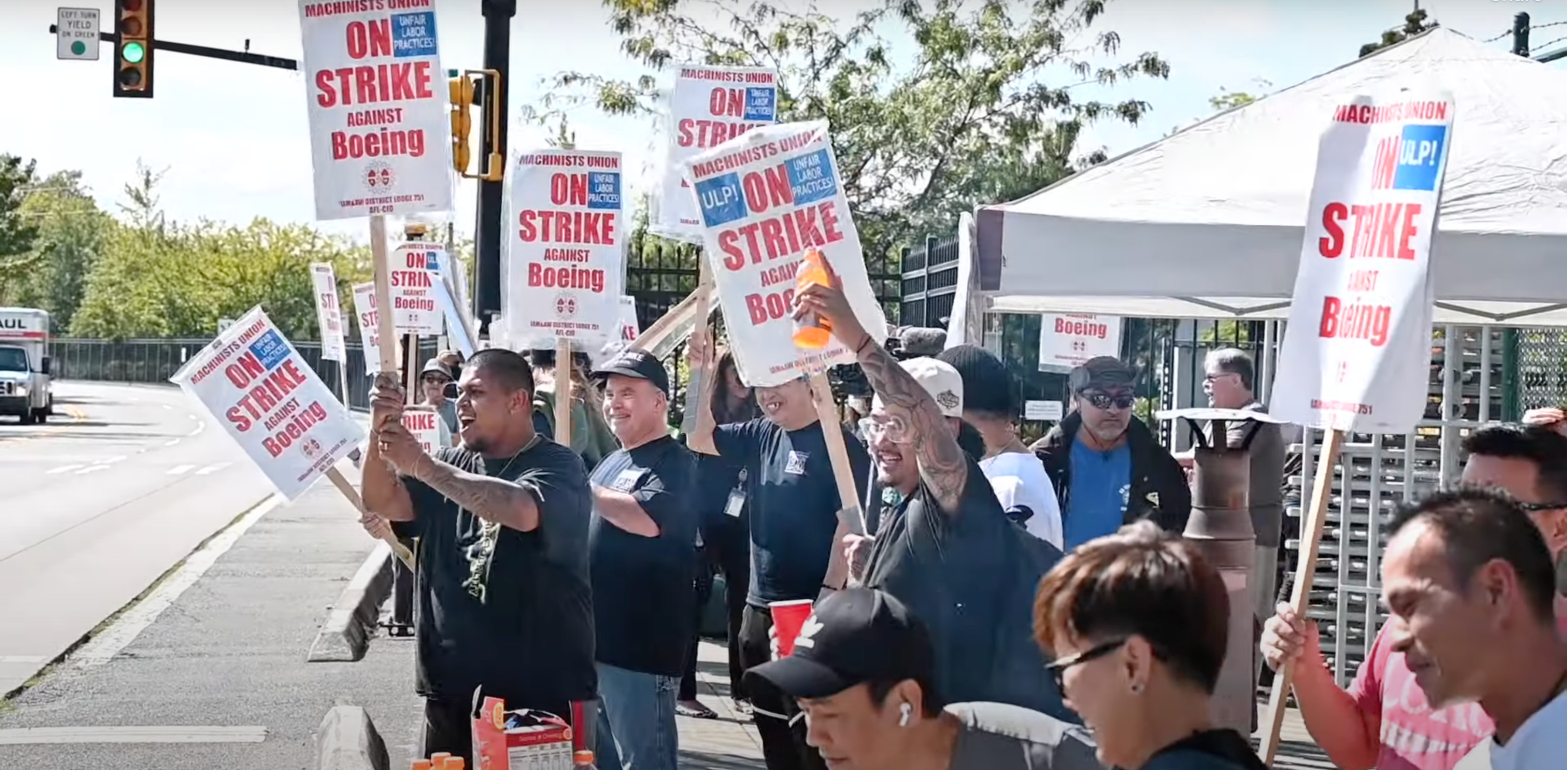
photo: IAM
by Peggy Wang
Massachusetts Teachers Association (personal capacity)
Boston, MA
In 2024, there were several militant union actions. 33,000 Boeing workers went on strike for nearly 2 months, only settling after rejecting three tentative agreements negotiated by leadership. 50,000 East Coast longshoremen struck for three days, disrupting the flow of $3.5 billion in goods they move daily. Both unions had not walked picket lines in decades – the Boeing workers since 2008 and the members of the International Longshoremen’s Association (ILA) since 1977.
Workers organized some of the largest successful union drives in recent history: 10,000 nurses at Corewell Health in Michigan joined the Teamsters in November, and 27,000 teachers in Virginia unionized in June. The Teamsters organized 75,000 new members in 2024. In December, unions at Amazon and Starbucks attempted nationwide strikes to get the corporations to negotiate first contracts.
Despite these efforts, workers haven’t been able to secure some of their most important demands. Neither the United Auto Workers (UAW) at Ford, GM, and Stellantis nor the Boeing workers have been able to bring back pensions lost in 2008 and 2014 respectively. While workers seemed to win significant wage increases (Boeing workers secured 43% over 4 years, the ILA 62% over 6 years), starting wages for the two unions had been $20/hour, not much above minimum wage in some states. The gains, while good, aren’t enough to reverse decades of concessionary contracts with minimal or no wage increases. Boeing workers were forced to take 0.5% yearly increases for 10 years. Many union workers have been forced into two tiers of employees, where newer workers are paid less, receive fewer benefits, and have less job protection than other union members, despite doing the same work.
Union density dipped another year in a row in 2024 to a record low of 9.9% – less than half of what it was 40 years ago. There are still no first contracts at Amazon, Starbucks, or Trader Joe’s, and some of the Amazon workers who went on strike in December have been illegally fired. Companies are getting away with violating contracts, outsourcing and offshoring jobs, and implementing layoffs, despite large handouts and tax breaks from both corporate parties, Republican and Democratic. The UAW is fighting layoffs of thousands of workers at the Big 3 auto companies.
Members looking to reform their unions need to critically examine and draw lessons from developments since the Teamsters and UAW elected new leadership. Already, a reform caucus of unionized US Postal Service letter carriers is calling for open bargaining, $30/hr, the right to strike, and a workers’ wage for union leadership. These members were left in the dark as the leaders of their union, the National Association of Letter Carriers (NALC), spent 20 months in closed-door negotiations. NALC members want a stronger contract to fix being increasingly underpaid and understaffed: they’ve experienced a 59% turnover rate and the lowest wage increases of any profession.
Time For Unions to Get Political: Organize a Workers’ Party!
At a time when public support for unions is high (70% in 2024) and when many non-union workers say they’d join a union if they could (48% in 2017, and likely more today), the labor movement is failing to face up to the task.
In 2023, unions had $35 billion in net assets at their disposal – a 146% increase since 2010. Yet union membership has largely stayed the same in that time: between 14 and 15 million. If half of the 128 million non-union workers in the US joined unions today, union membership would increase more than fourfold. But achieving this requires unions to abandon bureaucrats’ failed strategy of lobbying and supporting Democrats and to adopt an entirely new approach: one where unions commit finances, staff, and resources toward mass union drives and militant strikes especially at major corporations like Walmart, Amazon, CVS, and Tesla.
Unions need to unite in order to overcome the high turnover rates and low wages that can undermine organizing drives. Unions can’t take on the likes of Amazon – where half of workers are food insecure, half are housing insecure, and the turnover rate is 150% – without thinking bigger and broader. We need large, sector-wide fights in food service, healthcare, retail, and logistics. We need increased minimum wages across the board at the local, state, and federal levels. We need our unions to get political (meaning independently political of the two-corporate-party system) and to unite workers in our shared interests, regardless of whether we’re union or non-union, employed or unemployed, immigrant or not, a worker in the US or a worker in Mexico, Germany, India, China, Brazil, or Ethiopia.
The best way to achieve this is for unions to help build a workers’ party. While labor bureaucrats have spent billions on elections for the two corporate parties (over $1.8 billion in 2020 and likely more in the recent election), union membership stagnates, our wages haven’t kept up with the cost of living, and our healthcare costs increase. It’s vital for union members to fight for money and organizing resources to be put instead toward an independent, non-corporate political party that can represent working people’s interests. The Democratic and Republican parties alike serve the interests of their funders: the capitalist class. Workers need our own party, and our own voice.
A workers’ party would help union members reclaim the labor movement by bringing together the power and numbers that can organize militant strikes that shut down production, build mass pickets that block scab labor, and even coordinate workplace occupations. It could free workers from the limits of the pro-corporate National Labor Relations Board, court systems, and judges. If unions go beyond just their current numbers and fight with the support of the broader working class, we can enter each battle against the bosses with greater strength and win unions for millions, first contracts, a $30/hr federal minimum wage, universal healthcare, and much more.
Striking and Organizing Under Trump
The 200,000 members of the NALC are voting in January on a contract offering meager 1.3% yearly increases. The reform caucus Build a Fighting NALC are calling for a no vote, which could open the possibility of arbitration or even a strike. Other contracts expiring in 2025 include those for 57,000 healthcare workers at Kaiser Permanente, 35,000 public teachers in Los Angeles, and 55,000 homecare workers in Washington state. 28,000 United Airlines flight attendants have voted to strike, and the 225,000 members of the American Postal Workers Union are still in negotiations.
Though there are some major upcoming union elections on the horizon – 4,700 Amazon warehouse workers in North Carolina with the Teamsters, and thousands of auto workers at Ford’s BlueOval SK EV battery plant in Kentucky with the UAW – much more is needed. Just this past summer, 63,000 public-sector union workers in Florida lost union representation. And overall union membership in the private sector decreased by 184,000 in 2024. Further attacks during the Trump administration, including cuts to public services and public-sector unions, will threaten the labor movement.
2025 will need to be a year for union reform efforts to make unions more democratic and stronger and to elect leaders who will fight for a united labor movement, militant tactics, and independent political action to take on the corporations and their political parties in government.
 Independent Socialist Group