
by Angus McFarland
Maine
Donald Trump won the 2024 US presidential election with a narrow majority of the popular vote (76.9 million to Harris’ 74.4 million, a difference of 2.5 million), yet a large margin of the undemocratic Electoral College vote (312 to 226). Working-class people are rightly concerned about the brutal attacks that will come from a second Trump Presidency. Many commentators in the US have been wringing their hands and trying to figure out how he was able to win a second term, and what went wrong for the Democratic Party. Some argue that US society has become far more right-wing and that the Democrats, despite running arguably the most right-wing race in their modern history, were punished for being further left than the voting public on “culture war” issues.
The assumption implicit in this argument is that the working class has undergone a shift to the right in its thinking and opinions. This is wrong. In fact, if we look closer at the results of the ballot questions and races other than the presidential race, a very different picture appears. Ultimately Harris and the Democratic Party were unable to defeat Trump, not because they were to the left of the voting public, but because they represent and defend the same capitalist system as the Republican Party.
An election is a snapshot of a political moment, and is inherently limited in what it can tell about the movements, ideas, and interests that form the political character of a time and place. But by investigating deeper than the presidential result, and adding other trends observed outside of the frame of the election, we can come up with a far richer and more truthful depiction of the political mood of the working class.
Class Politics Emerging
Workers have experienced declining living conditions, particularly over the last few years. This was reflected in the election results.
In pre-election polls, 81% of voters expressed the economy being their #1 issue in the elections. 93% of Trump supporters considered the economy very important to their vote. Inflation has increased 21% since 2020, minimum wage has remained at $7.25/hr since 2009, and housing costs are at a record high (22.25% since 2020).
Ballot questions can tell us important things about the kinds of policies voters favor without the “fog” of voting for personalities and parties. While they are often overturned in courts, whittled down in subsequent legislation, or undermined in other ways, and therefore are an imperfect solution at best, they do allow people to express their opinions on an issue directly.
Abortion has long been an important wedge issue, with both Republicans and Democrats using it to fundraise and motivate lesser-evil voting. Despite the 2022 Supreme Court decision overturning Roe v. Wade, 70% of Americans supported abortion in all or most cases in a poll from June 2024. In November, in ten states where abortion was on the ballot, vote results in eight of them showed a clear majority in support of the right to choose, including several traditionally “red” and swing states. While Nebraska did pass a ban on abortion after the first trimester, there were two competing ballot questions and the constitutional right to abortion still won 49% of the vote. Far from a massive rightward shift, these results show that reproductive rights remain popular with a large majority of Americans.
Ballot questions related to labor rights also did well. Voters approved ballot measures making it easier for cannabis workers in Oregon and for rideshare drivers in Massachusetts to unionize. Arkansas & Missouri passed measures to increase the state’s minimum wage to $15 per hour. These two states, along with Nebraska, also passed paid sick leave requirements. Maine passed a bill to limit PAC contributions to $5,000 which, while a limited reform, is nevertheless an indication that people in Maine want to limit the influence of big money corporate donors over elections.
The Dan Osborn independent campaign for Senate in Nebraska against the Republican incumbent Deb Fischer was a very strong effort that was narrowly defeated (47% to 53%, read more on page 12) Osborn, who previously led a strike at Kellogg’s as president of a UFCW union local, refused the endorsement of the Democratic Party and showed that an independent working-class candidate can compete, even for a seat considered safely Republican.
Democrats Threw Away The Election
If a majority of the voting public, and likely an even larger majority of the overall public, is in favor of these pro-worker policies, why did the clearly reactionary Trump win the election? There are a number of dynamics at play in the American electoral system that help to explain.
In the US, political thought outside of a narrow band of pro-capitalist ideology is pushed so far to the margins that there is little functional difference between which of the capitalist parties is in power. Especially in the arena of foreign policy, but also increasingly in domestic policy, there is no thought that there is meaningful democratic control over the agenda enacted. There is such a slim and vanishing hope that anything can be done about the hated American healthcare system, for example, that neither candidate even bothered to make false promises about it in the last election. In such a state of affairs, where many do not feel that their votes will have a real or strong effect, the vote becomes about voting against one party rather than for the other.
This is expressed in the dynamic of “lesser-evil” voting, a double edged sword that can harm either the Republican or Democratic parties, depending on who the individual voter perceives as more evil at the given moment. In a situation where there is only ever a choice between evils, support tends to be tentative and changeable.
There are certainly hardcore Trump supporters who thoroughly embrace right-wing ideas. But there are many more “soft” Trump voters who, for a variety of reasons, could not bring themselves to tick the box for the Democrats, and saw only one other choice. These voters are likely to split the ticket and vote for more progressive candidates down-ballot, particularly independents, and support pro-worker ballot questions.
Of the whole population of voting age adults, only about 52% saw any utility in voting at all, only 27% were convinced to vote for Trump, and of those who voted for Trump, only a smaller – though admittedly difficult to quantify – section are actual “hard” supporters.
What best accounts for Trump getting elected twice is a growing dissatisfaction with the status quo. The first Trump term was a reaction to the failures of the Obama administration to raise living standards, end the war in Iraq (and elsewhere), pass universal healthcare, shut down torture programs such as at Guantanamo Bay, and more. Many working-class people’s lives were devastated by the 2007-2009 Great Recession, during which Obama bailed out banks and large corporations while allowing mass home foreclosures and the removal of pensions for many union workers. There were many who thought that at least a Trump presidency would create some kind of change, and almost anything would be better than more of the same. His rhetoric around “draining the swamp” and his claims to be a Washington outsider spoke to people’s real need for change (read more about why the Democrats are a dead end for progressives and stopping the right on page 10). When Trump in turn failed to improve the lives of the majority of Americans, his popularity fell, such that he was unable to secure a second term. Biden was elected as the “somebody other than Trump” candidate, and vowed that “nothing would fundamentally change” under his watch, i.e., he would be the champion of the status quo that voters had just rejected four years before.
The Biden administration laid the grounds for Trump and Trump-like figures to make a comeback by refusing to entertain the idea of universal healthcare during the pandemic, bailing out big business (again) during the Covid recession, taking no measures to stop historic “greedflation”, allowing the overturn of abortion rights, and backing Israel’s genocide in Gaza. Kamala Harris, running in Biden’s place when it became obvious that he was too decrepit to run, defended and campaigned on the same unpopular policies, which didn’t work as an election strategy because it offered no prospect for change.
Essentially the voting public is oscillating between two evils, and having an increasingly hard time telling which of them is greater or lesser.
“Though she’d previously campaigned in 2019 on ending fracking, she reiterated in speeches in 2024 that she wouldn’t ban fracking. Despite running with Biden in 2020 on closing border camps and the border wall, she spoke this election cycle of being tough on immigration. She promised to build up the military, and in the eleventh hour before election day, finally stated her support for an increase of the federal minimum wage but only to a meager $15/hr. Fundamentally, her campaign offered little different from Trump in terms of policies that would immediately address the crises in cost-of-living, housing, healthcare, childcare, and education that working people face. Beneath their speeches and spin, both Harris and Trump, along with their parties, are funded by corporate interests and have similar core policies in defense of capitalism and imperialism.” (Independent Socialist Group statement on the elections, 11/6/2024)
A serious strategy to defeat Trump would have been to offer real improvements. Left demands like universal healthcare, raising the federal minimum wage, taxing the rich, and many others are overwhelmingly supported by voters. The Democratic Party has repeatedly refused to move in this direction, dangling reproductive rights, student loan cancellations, and closing the ICE detention camps in front of workers’ faces during campaigns and then abandoning these demands once in office. Despite many chances over the years, including periods under Clinton, Obama, and Biden when Democratic administrations controlled both houses of Congress, they refused to codify Roe v. Wade to fully legalize abortion in the US, while running and fundraising on the issue endlessly.
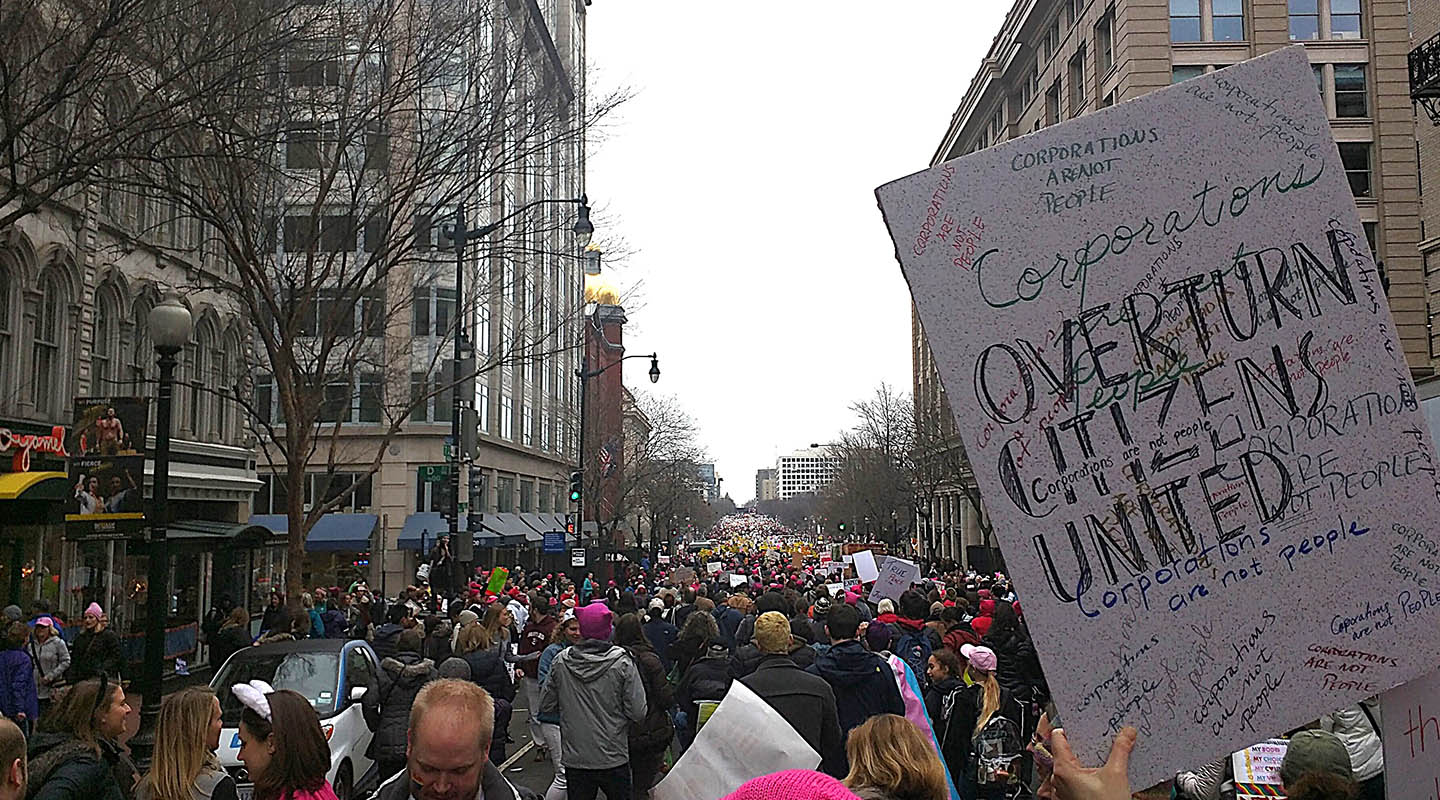
The Democrats are also adept at derailing and co-opting mass protest movements which can challenge the right in the streets. The Anti-Trump marches, Black Lives Matter, and the protests against the overturn of Roe v. Wade are just the most recent in a long history of movements that dissolved into calls to “vote blue” and donate to Democrats, only for their demands to be dropped and forgotten in the next election cycle.
By posing as the representatives of the left in US politics, while in reality working to prevent independent working-class political representation, the Democratic Party has created an enormous vacuum for real left, class-based politics. As policies of the Democrats fail to make real improvements in the lives of the vast majority of working people, the hunger grows to fill that political vacuum. Some will turn to Trumpism in the vain hope that he will somehow represent the concerns of some working people, but there is also a tremendous opportunity for a new political party to emerge that is in reality of, by, and for the working class.
Trumped Again
Trump ran on a platform of right-wing populism that got him across the finish line of the presidential race against an unpopular incumbent. His claim that he can improve the economy by imposing tariffs will likely only help to increase inflation and economic instability, as similar tariffs under both Democratic and Republican administrations have done in the past.
The incoming Trump administration is also promising mass deportation, a further attack on working people. Despite both corporate parties campaigning on “tough on immigration” policies, US capital relies heavily on the cheap and vulnerable labor force that undocumented immigrants represent. Undocumented workers constitute 22% of agriculture workers, 15% of all construction jobs and 8% of all manufacturing jobs. There have been a number of high-profile labor violations involving undocumented workers, such as in the meat-processing industry. Tyson was found to have undocumented children working in its production facilities, cleaning dangerous equipment and working overnight. Businesses profit immensely from desperate workers threatened with illegal status or deportation. Mass deportations won’t solve the severe problems of low wages and job insecurity which are the result of a weakened labor movement, no political party representing working people, including immigrants, and the corporations driving down wages to increase profit rates under capitalism. Solidarity between workers, whether immigrants or not, is the way for workers to improve conditions for all and cut across Trump’s divisive tactics.
Trump has promised to end the war in Ukraine without revealing any sort of plan. At the same time, he has promised ominously to “finish the job” in Palestine, referring to completing the genocide, continuing the policies of the Biden/Harris regime. No one should be fooled; Donald Trump is not a peace candidate. He has stuffed his cabinet with war hawks and is hell-bent on ratcheting up tensions globally, particularly with China. A Trump presidency will reflect a superficial change in priorities of US imperialism, not a lessening of its intensity.
And then there will be the job that his capitalist backers really put him there to do: more tax cuts for the rich, cuts to social services for the working class and poor, and deregulation.
As the Trump administration takes office, it will be unable or unwilling to do anything but sharpen the many crises in which capitalism finds itself. The Democratic Party will continue to be far to the right of the populace it claims to represent. These factors will mean a huge opportunity for true left, socialist politics. A mass, left worker’s party – made up of working-class people including socialists, progressives, and organized labor – backed and funded largely by unions, and firmly independent of the two existing capitalist parties, would have the potential for massive popular support.
There were independents of various kinds running in the 2024 presidential race. The left and independent/third party campaigns were, for the most part, unable to take full advantage of the mass anger against both corporate parties, present a broadly appealing political program, and win significantly more of the vote share. The main challenge for these campaigns was a lack of material resources. These presidential runs were iced out by the corporate media and didn’t gain enough traction or large enough profiles to get onto the radars of most working people in the US.
Of the three notable third-party campaigns that ran in 2024 – Jill Stein of the Greens, Cornel West, and the Party for Socialism and Liberation (PSL) candidate Claudia De La Cruz – none managed to garner votes in significant numbers (the Greens got the most, at 0.55% of the total votes). If these parties had unified early in the election process, they could have increased their public profile and provided a stronger basis to build the foundation of a workers’ party.
The working class needs its own political party in order to break the stranglehold of the ruling corporate duopoly. But a workers’ party will need significant material backing – finances and resources – to get off the ground. Unions can play a major role in this: in 2020, unions spent $1.8 billion on the elections. If unions can help pool money, staff, and membership toward a workers’ party, even starting at the local or state level, it can make some major breakthroughs and help lead campaigns for higher minimum wages, improved funding and staffing for public schools and hospitals, taxes on the rich and large corporations, and much more. It can open the way for demands neither corporate party will touch, such as nationalizing key sectors of the economy such as heating, electricity, the internet, and healthcare, as well as point the path toward socialism.
 Independent Socialist Group