
by Nick Wurst
SMART-TD Local 1473 & Railroad Workers United (personal capacity)
Worcester, MA
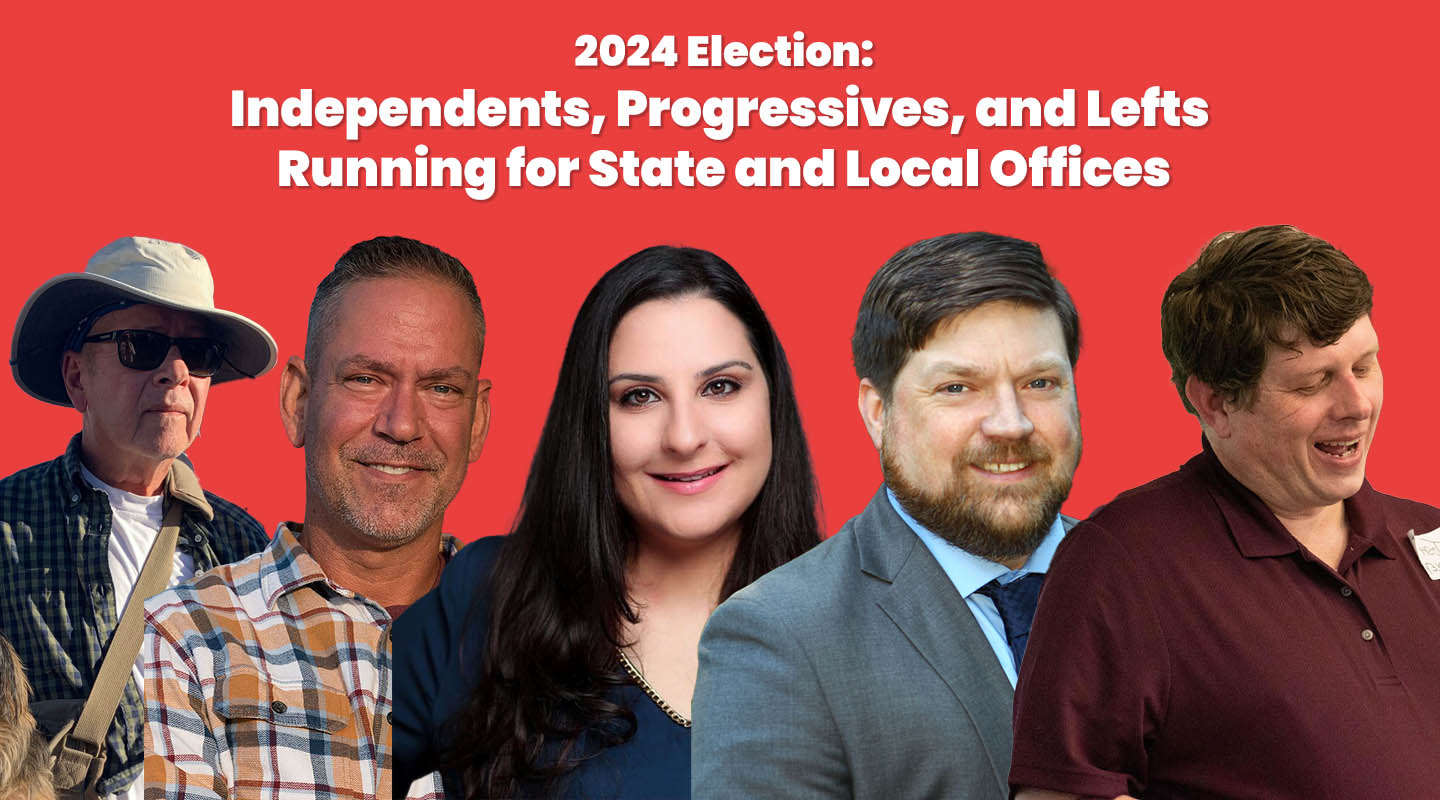
There are hundreds of independents, Greens, and left candidates who are running for office across the United States. Working-class people supporting these campaigns can be a step toward building a workers’ party. Here we highlight a few campaigns.
Dan Osborn – Nebraska
In Nebraska, union steamfitter Dan Osborn continues his working-class bid for US Senate, taking on Republican Party (RP) incumbent Deb Fischer. Uncompromisingly independent, Osborn has refused endorsements from the Democratic Party (DP) and taken no corporate money. Since our initial article in February, Osborn has secured endorsements from the state AFL-CIO and out-fundraised his opponent, accepting donations from working-class people and unions. “Unlike Deb Fischer, I’m not taking corporate PAC money from Pfizer, Boeing, Facebook and JBS,” Osborn said in a statement. “No one’s going to own me when I get to Washington.” (Nebraska Examiner)
His campaign has highlighted important working-class issues like increasing the minimum wage, making it easier to join unions, and stopping government handouts to “hugely profitable pharmaceutical corporations”. Osborn’s campaign demonstrates once again that it’s possible to avoid the trap of the corporate Democratic Party. The Osborn campaign is the most exciting development in the current elections with a serious chance to win and is the only independent campaign with major union support. If Osborn wins in Nebraska, it lends credibility to the idea of running as an independent. One key idea that ISG would raise is for the Osborn campaign to help launch an effort for a new party for working people, one which would identify and run more candidates on a similar platform to the Osborn campaign, with the same no-corporate-money pledge, and with internal democracy. If Osborn gets to the Senate, he will face tremendous pressure to “play ball” and compromise with the corporate parties in the spirit of “getting things done.” A party which can mobilize supporters to rally public pressure to help him break deadlocks and stay true to the working-class people who elected him.
Green 13 Slate – New Jersey
The Green Party (GP) has firmly maintained political independence from the capitalist class and its two parties. Many on the left are drawn to the GP and run campaigns on its ballot line. Not all Green Party candidates or state Green Parties are left or run on strong progressive programs and this is why the Independent Socialist Group (ISG) does not endorse the GP as a whole.
The New Jersey Green Party, demonstrating the importance of maintaining a ballot line and the opportunity for leftists to use the GP ballot line, is fielding candidates for a US Senate seat and all 12 House of Representative seats. The candidates’ platforms highlight a wide range of issues, including calling for universal healthcare, ending the housing crisis, and establishing a federal jobs guarantee. For example, the Christina Khalil for US Senate campaign “supports a myriad of solutions including access to public banking, increasing the minimum wage…and the expansion of public housing through repealing the Faircloth Amendment.”
Jason Call – Washington
Jason Call is a Green Party candidate for US Congress in Washington state’s 2nd district. Call got involved in the Democratic Party in 2016 because of Sanders’ support for the DP, getting elected to the DP State Central Committee. He campaigned for the 2nd congressional seat in 2020 and 2022 as a “progressive” democrat, following the failed strategy to try and reform the Democrats championed by Sanders, AOC, DSA, etc. He left the DP in 2023, realizing “The sad truth is that the Democratic Party, like the Republicans, is owned and controlled by Wall Street and the War Machine”. He was recently arrested on the campaign trail with Jill Stein when they attended a protest at Washington University against the ongoing genocide in Gaza. His campaign program highlights ”Medicare for All, Tuition Free College, Climate emergency, Strengthening Labor, and Ending Endless War.”
Eduardo Quintana – Arizona
Quintana is a Green Party candidate for Senate, running on a pro-worker, pro-climate, anti-war platform. However, in an example of the dirty tricks used by the corporate parties as well as the problems with the primary system, the DP and RP both planted candidates in the GP primary to run against Quintana. The AZ Secretary of State, a Democrat, even declared the DP plant as the winner of the primary, until the GP managed to correct the record.
Joshua Bradley – Raleigh, North Carolina
In North Carolina, Joshua Bradley is a joint Green Party and Socialist Party USA (SPUSA) candidate for the Raleigh City Council. Bradley was heavily involved in the Occupy movement in Raleigh and is involved in both the GP and the SPUSA . His campaign has five main themes in its program: “Housing Justice, Racial Justice & Equity, Workers Rights, Environmental Justice, Non-discrimination & Community Inclusion.” The joint effort between the GP and SPUSA is reminiscent of the 2020 Hawkins/Walker GP campaign for president. Hawkins and Walker won the candidacy of both the Greens and the SPUSA and were supported by several other left groups, including the Independent Socialist Group.
Far-Left Campaigns and the Need for Unity and Broad Appeal
There are other far-left campaigns running in local and state races. These groups don’t have the name recognition or infrastructure of the Green Party and usually have a much narrower program, which can alienate workers who do not already consider themselves socialists. Some of these efforts can be genuine, but often these parties are solely interested in building their own organizations and not working to build a broader party for the working class.
The Working Class Party (WCP) has 15 candidates running in Michigan, Illinois, and California, including 7 House of Representative races in Michigan. The WCP has an explicit anti-capitalist program. In some of the Michigan races, there are also GP candidates present. The GP is a somewhat politically mixed party, which can mean it can have more conservative and anti-socialist elements in some areas. The WCP should not withdraw in favor of these sort of Green Party candidates. However, the WCP should not run in races where left, progressive, and ecosocialist Greens are running. There should be discussion about tactical unity between the left within the GP and the WCP to determine if there are any races where either party’s candidate can withdraw and throw their support behind the other in the interest of building the highest profile and best possible vote for a left candidate and program, as well as to take steps towards establishing a new mass workers’ party.
In the California 37th congressional district, the WCP candidate Juan Rey advanced to the general election against the DP incumbent with 10% of the vote in the primary. It’s worth noting that the candidate with the third most votes but who did not advance to the general election was a candidate from the Peace and Freedom Party (PFP), another left-wing party with a long history. The PFP worked together with the California GP to put forward a “Left Unity slate” in several 2024 races. Unfortunately none of the candidates advanced to the general election. It seems that an agreement could not be reached between PFP and WCP in order to combine forces – a missed opportunity, if discussions along those lines occurred. It’s also unfortunate that the PFP primary and state convention settled on nominating and endorsing the Party for Socialism and Liberation (PSL) campaign for the Presidency, rather than the Cornel West campaign, which ran for the party’s nomination, or the Jill Stein campaign, which did not. Either of these campaigns are more likely than the PSL campaign to have a broader appeal to working class people and have a stronger vote result. Part of the effort for forming a nationwide, mass workers’ party will be overcoming unprincipled divisions between different left and progressive groups while still allowing for debate and principled disagreements, all while putting forward a progressive or socialist program that appeals to the broadest possible layer of working class people.
Why Socialists & Working-Class Activists Should Get Involved In Independent Left Campaigns
We include the below excerpts from previous articles which make the case for why socialists and working-class activists should get involved in independent left campaigns, including at the local and state level. Some small changes in the text have been made.
“Why Elections Matter in the Fight for Socialism” (November, 2022)
“Elections and voting are widely understood to be important for most working people. Socialists need to be involved in electoral politics, campaigning for the immediate demands of the working class by running working-class candidates independent of the two corporate parties. At its most basic, elections are an opportunity to discuss politics within our communities in a format people are familiar with. Socialists can organize standouts, rallies, public meetings, and go door-to-door to discuss progressive and socialist demands. Even in a country with no workers’ party, election campaigns are a public forum and an opportunity to organize people and raise the banner of independent left candidates as a step towards organizing a workers’ party. Election campaigns, even if they don’t win, can be used to successfully bring together different progressive and left organizations and activists to launch future political movements and electoral campaigns.”
“The capitalist class and the two corporate parties know that a workers’ party would be a huge threat to the capitalist system. It would give an organized political voice to the working class. It would be a real alternative to the corporate stranglehold of the two-party system. They have done everything possible to prevent us from establishing one, including inventing the current primary system, introduced in the early 1900s, to try and counter the rise of the Socialist Party of America.” Editor’s note: see this section of “The Case for an Independent Left Party” by Howie Hawkins and the example of the Democrats, Republicans, and the Arizona state government interfering in the Green Party primary in Arizona detailed earlier in this article under the subheading “Eduardo Quintana”.
“In the immediate absence of a workers’ party, working people and socialists should organize independent left electoral campaigns. These campaigns can be centered around a platform of clear, progressive or socialist demands, based on democratic decision-making and accountability for the candidates. Unions, progressive community groups, and left organizations should organize together to put forward working-class activists as independent candidates. Cooperation and discussion between these organizations and campaigns can help lay the groundwork for a workers’ party which would likely be made up of many different political trends represented by progressives, labor, and the left. A mass membership, dues-based workers’ party where the rank and file have real decision-making power, and regular local, regional, and national meetings to discuss, debate, and carry out initiatives and campaigns to clarify the best ideas, tactics, and strategies can win immediate gains for the working class.”
“Seattle City Councillor Kshama Sawant Not Seeking Reelection” (March 2023)
We include these excerpts, with minor edits, to highlight the victories that were won with just a single socialist elected to a city council, showing why even local independent left candidates can be more than just a symbolic campaign. However, there are also lessons about the dangers of the Democratic Party from Kshama Sawant and Socialist Alternative’s turn towards the Democrats, weakening the position on city council and ultimately giving it up. One of the major wins of the Kshama Sawant campaigns was the first city-wide $15/hr minimum wage, which the Democrats recently attacked. Since our article was published, Socialist Alternative and its international co-thinkers have suffered a number of crises and splits, most recently when Kshama Sawant and others departed the organization.
“Kshama Sawant first won the Position Two seat on Seattle’s City Council in 2013, in a campaign organized by Socialist Alternative (SA) which played a key role in the movement for a $15 per hour minimum wage across Seattle. She became the first socialist elected in nearly a century and won two more elections for Seattle’s Third District in 2015 and 2019.
In addition to the first $15/hour minimum wage in the U.S., Sawant and supporters in SA’s periphery won several victories in office. These included expanding rights for renters, taxing Seattle-based mega-corporations like Amazon and Starbucks, and preventing the Seattle Police Department from building a militarized police station in Seattle’s North Precinct.
While we celebrated Socialist Alternative’s victories in Seattle, over the years Kshama Sawant’s city council campaigns began to reveal deeper political issues and differences within SA around independent political action and how socialists should organize electoral campaigns. These political differences prompted internal debate and eventually the Worcester, MA branch and supporters across New England departed Socialist Alternative in 2019 because of SA’s support for the Democratic Party (DP). Many who left SA against the turn towards the DP founded the Independent Socialist Group.
Supporting Democratic Party candidates while at the same time claiming to be against the Democratic Party made no sense to many activists and working people becoming interested in socialism.”
“In 2020, corporate forces in Seattle spearheaded a right-wing recall campaign targeting Sawant, pouring over a million dollars into the effort and conspiring to hold the election in the off-season to drive down voter turnout. Socialist Alternative rallied the support of 20 unions and 1,000 volunteers to campaign against the recall, narrowly defeating it. ISG called on Socialist Alternative to use the momentum from this victory in 2021 to run more independent candidates and break with the Democratic Party.
Unfortunately, it seems the mistaken lesson Socialist Alternative took from their electoral experiences over the last eight years is that they should not contest an election that they might lose. Neither Socialist Alternative nor any of its successor organizations have run any candidates since the 2019 re-election. Sawant decided to not run for re-election in 2024, and Socialist Alternative did not run other candidates for City Council [in her place].”
Photo credit: Eduardo Quintana for Senate, Dan Osborn for Senate, Green Party of New Jersey, Call for Congress 2024, Joshua Bradley for Raleigh Workers
 Independent Socialist Group