
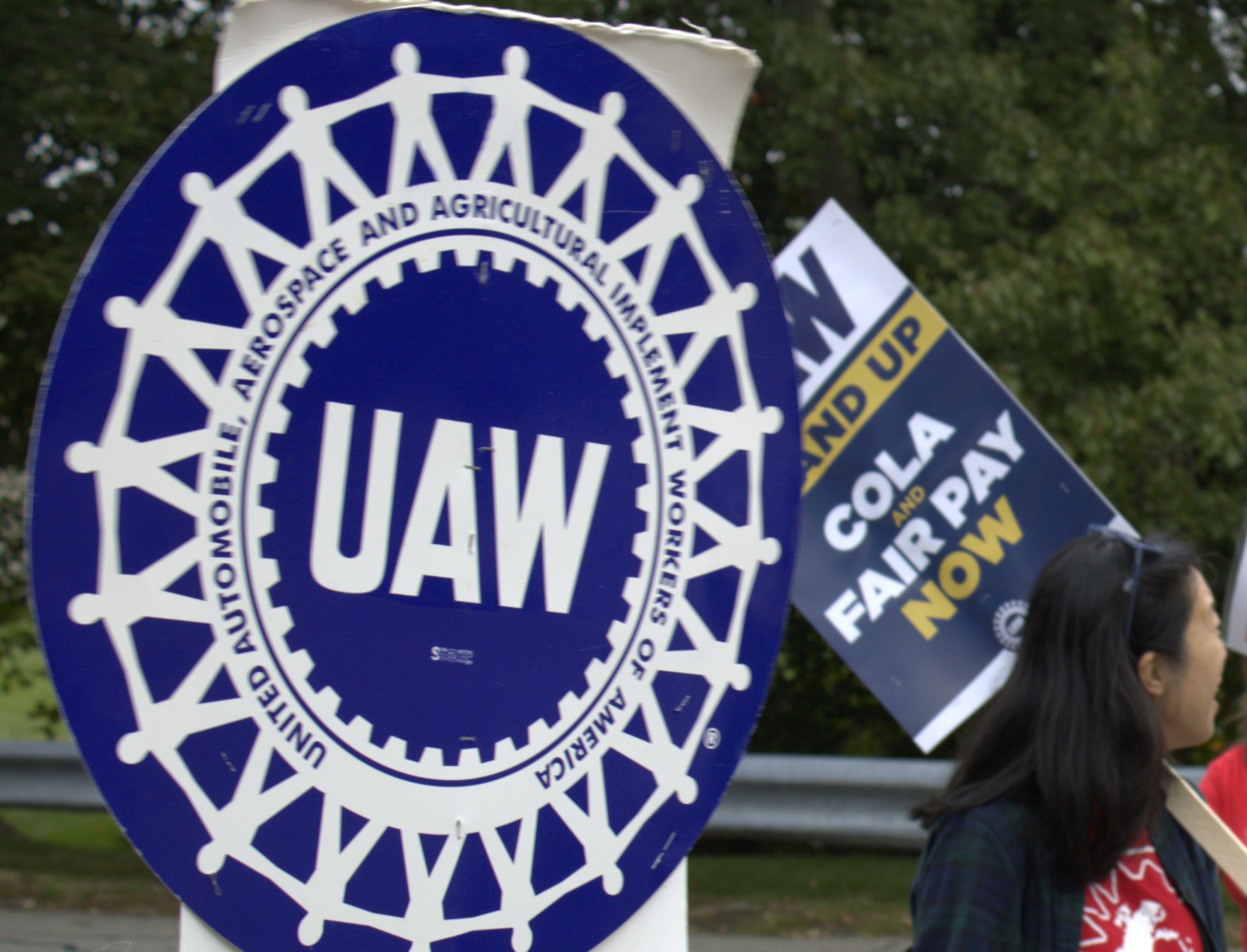
ISG members on the picket line during the Big 3 contract battle and strike in 2023.
Mansfield, MA.
by Jeff Booth
AFSCME Local 3650 (personal capacity)
Boston, MA
The United Auto Workers (UAW) is on the move with high-profile strikes and new union organizing, showing new determination to fight the big corporations. In April, the UAW reversed decades of defeat by winning a union organizing vote at Volkswagen in Tennessee. In May, the earlier win was partially eclipsed by a loss at Mercedes in Alabama. Is the momentum of the UAW stalled or is there an immediate way forward to build on the success of the union vote at Volkswagen?
Last September, workers in the UAW won simultaneous strikes against the “big three” car companies: Ford, General Motors, and Stellantis. The UAW made serious gains in wage increases, including long overdue, substantial raises, new cost-of-living pay adjustments and an end to unequal “two-tier” pay structures. (Read our coverage of the strike online).
Soon after winning the strikes, the UAW committed $40 million in new organizing funds through 2026 to organize non-union auto and battery workers, primarily in the South, and also announced in January that more than ten thousand auto workers had signed union cards to join the UAW in 14 non-union car factories around the country, including a majority of workers in two Volkswagen plants in Chattanooga, Tennessee.
The momentum from the election of a new UAW President, Shawn Fain, by direct vote of the members in March 2023, along with the UAW strike victories against the big three, and a serious commitment of union resources to new organizing all helped win a crucial vote for 4,300 workers in Chattanooga, Tennessee at two Volkswagen car factories. The UAW had lost union elections in 2014 and 2019 at the same factories but in April, there was a huge shift to “union yes” at Volkswagen with a super majority of 73% of the votes for joining the UAW. 3,613 workers voted for the union versus only 985 who voted company. Turnout was 83.5%. It was the first union organizing win at a foreign owned vehicle assembly facility and the first at a Southern auto factory since the 1940s.
The labor movement widely celebrated the victory at Volkswagen as a historic moment in the history of the UAW and a first step towards bringing 150,000 non-union auto workers into the ranks of the UAW. These include unorganized workers at Toyota, Honda, Mercedes, Hyundai, Nissan, Subaru, Tesla, and others. Winning the union election at Volkswagen strengthened workers throughout the UAW and continued the upsurge in labor movement struggles for organizing non-union workers and reversing concessionary contracts.
Later in April, the UAW rolled on with a contract victory at Daimler Truck factories in North Carolina. 7,300 Daimler Truck workers were ready to walk out on strike when the corporation blinked and UAW members won a contract including 25% raises over four years, cost of living pay increases, and eliminating wage tiers.
Other unions are gaining ground in the South and other regions, based in part on the UAW wins within the last year. On May 16th, the Communications Workers of America (CWA) and the International Union of Electrical Workers (IUE), now a part of CWA, announced that 600 workers in Anniston, Alabama had organized and won a first contract at the New Flyer electric bus plant, owned by one of the world’s largest bus building corporations. The union negotiated pay increases of 25-38% by 2026, restrictions on forced overtime, more paid time off including parental leave, and Juneteenth as a holiday.
In May of 2023, workers at Blue Bird Corporation in Fort Valley, Georgia voted to join the United Steelworkers (USW) union. Blue Bird Corporation makes electric buses and is one of three major bus manufacturers in the US. Before winning the union election in 2023, wages were extremely low, ranging from $13 to $25 an hour with a high turnover in the workforce. There were also major problems with safety in the Blue Bird factories. The company was wallowing in federal subsidy money but still tried to break the union drive with anti-union terror tactics including threatening to close the factory, telling workers that no other company would hire them if they joined the USW. The union-busting campaign failed with the mostly black workforce voting 697 to 435 to join the union. A year later, in May 2024, the 1500 workers at Blue Bird won their first contract. The three year contract includes raises ranging from 12% to over 40% and improvements in health and safety.
The important union victories in contract struggles and strikes in southern states by the UAW and other unions are happening within the context of a general upsurge in union wins around the US last year and into 2024.
Mercedes, Corporate Politicians, Preachers, Football Coaches, the Whole Damn Capitalist Class
Less than a month after the workers at Volkswagen in Tennessee won their union election, voting started at the next non-union auto factory complex, Mercedes, in Vance, Alabama, with about 6,100 workers. The results were 2,045 for the union but 2,642 voted corporate. Capitalist politicians and their corporate masters were pleased. The anti-union campaign was vicious and effective, using the corporate media, anti-union consultants, harassment of pro-union workers, mandatory “captive audience” anti-union meetings, a daily flood of anti-union texts, etc. The governor of Alabama used her political position for the anti-union campaign. After the vote, she said: “The workers in Vance have spoken… Alabama is not Michigan, and we are not the Sweet Home to the UAW… automotive manufacturing is one of Alabama’s crown jewel industries… and we are committed to keeping it that way.” The Business Council of Alabama (BCA) was another tool for the Mercedes corporation. Helen Duncan, BCA president, praised the governor’s anti-union use of state government: “…BCA and our allies were successful in our efforts to keep the UAW out of Alabama… I would like to extend a heartfelt thank-you to Governor Kay Ivey for her support.” Mercedes also used their own bought-and-paid-for pastor and city council member in Tuscaloosa, Matthew Wilson, to propagandize against the union and to try to divide the workers by race in the factories. Mercedes even got a famous football coach, Nick Saban, to spew against the union. Saban owns multiple Mercedes dealerships.
The UAW filed charges with the National Labor Relations Board (NLRB) to have the election results overturned because the Mercedes corporation interfered with the union campaign. Unfortunately, the anti-union campaign by Mercedes is business as usual and similar to most anti-union campaigns by large corporations, including the use of corporate politicians, religious authorities, corporate media, threats, intimidation, all backed by the capitalist state.
New Momentum, the Way Forward
The immediate way forward for the UAW and the rest of the labor movement is to combine money and organizing resources of all the big unions behind a mass campaign to get a substantial first contract, immediately, at Volkswagen. And then use the organizing win and a good first contract to organize the next union vote at a car corporation, for example, at Hyundai.
Analysis about the loss at Mercedes tends to focus on details of union organizing strategies, like how many organizers to use, what the main talking points should be, whether home visits or in-person meetings should be used instead of texts and Zoom meetings, etc. Detailed organizing plans are extremely important but even more crucial is union leaders and activists learning or re-learning the basics of how to force union recognition through strike action, how to get first contracts quickly, and how to enforce contracts. Solidarity strikes and workplace occupations, backed up with mass pickets and protests of union members and supporters are necessary tactics.
Even in the short term, to make our unions stronger, more democratic, and unified, we need to begin to organize a political party for working people. A workers’ party independent of corporate money and independent of the Democratic and Republican Parties will enable real unity and active solidarity between unions, bring unorganized workers into the labor movement in mass numbers, and win social benefits that other countries take for granted due to having political parties independent of the capitalists. To defeat union-busting, layoffs, outsourcing, workplaces shutting down, and to fight for the entire working class, unions need to lead the organization of an independent political party for the working class. We need to break with business unionism and corporate politics. The labor movement in the US and internationally will only survive and become a powerful force through independent politics and socialist unionism.
 Independent Socialist Group