
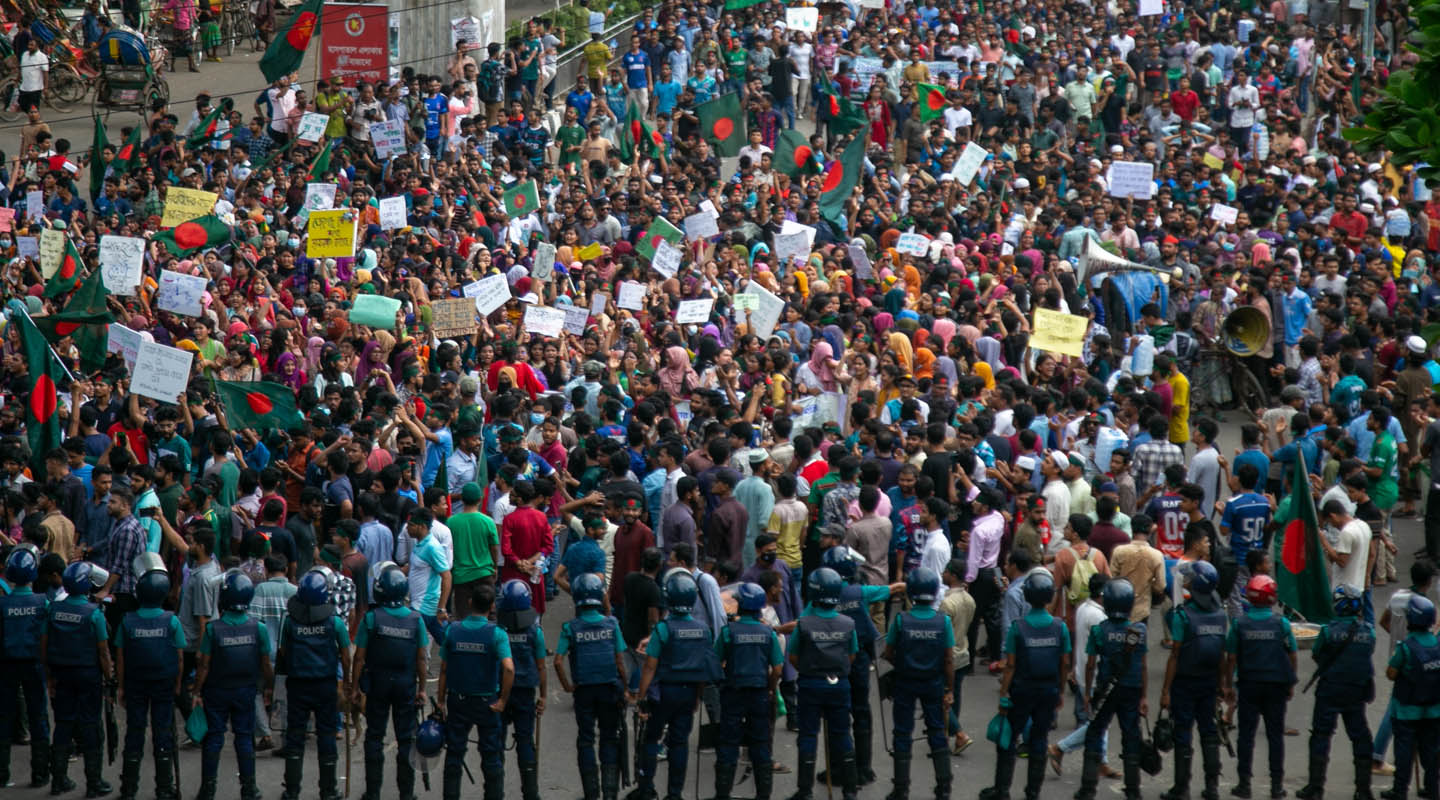
Bangladesh quota reform movement, July 6, 2024
Photo by Rayhan Ahmed (Wikimedia)
by Savana Mazumder
Springfield, MA
The global crises driven by capitalism and imperialism have converged in recent years to spark revolutionary moments around the world. The student-led mass protests in Bangladesh are a reaction to many of the same material forces as in nearby Sri Lanka, where the 2022 mass movement ousted the president. High inflation, electricity blackouts, shortages of fuel and other basic necessities have ravaged the lives of working people in both countries – meanwhile, the capitalist class and capitalist politicians who are responsible for these conditions have enormously profited.
In June, students began organizing demonstrations through “Students Against Discrimination”, an umbrella organization of students protesting against a 30% quota system for public jobs reserved for descendants of veterans of the Bangladesh war for independence. Civil service and other public sector jobs are highly sought after, generally offering better pay and benefits than the private sector, and are seen as a way out of poverty for youth with access to the required education. Sheikh Hasina, leader of the Awami League party and Prime Minister of Bangladesh, had reintroduced this quota for government jobs that favors those related to people in her party. If you don’t know the right people, then you’re forced to either languish in unemployment or low-paying jobs, or find the means to leave Bangladesh to try and find work.
The Awami League responded brutally to the student protests with a police and military crackdown, killing 819 people as of August 22. The protests continued to escalate in August and ousted Hasina, who has ruled Bangladesh for the last 15 years. An interim government has been established, which includes some leaders of the student protests but the new government is primarily under the leadership of capitalist Muhammad Yunus.
Yunus is an economist who specializes in “microcredit” and “microfinance”; essentially, the corporate strategy of giving small loans to the poor, primarily Bangladeshi women, in order to encourage them to start businesses. However, the micro loans are a form of exploitation, with high-interest rates resulting in chronic debt-burdens. The person who seems to benefit most from his dealings in microfinance is Yunus himself – a millionaire made such by the labor of poor Bangladeshi women. He might want to present the formation of this new interim government as a new beginning for Bangladesh, but his background in microfinance emphasizes his ties to the global capitalist system. Indeed, his twin focuses on preparing for a “free and fair election” and wanting to reinforce “peace and order” does not bode well for the average working-class Bangladeshi who wants to see an end to the exploitation of their country for the profit of others and a future for themselves.
The interim government, and any new government made up of the establishment parties will not satisfy the demands of the protestors, which include safe, decent jobs for everyone with livable pay, the right to protest, and an end to the brutalization of the student movement by the army and police. The Bangladeshi public have largely lost faith in the Awami League, Bangladesh Nationalist Party (BNP), and the Jamaat-e-Islami party. The Awami League, which has been the main party for the last 15 years, has courted such entities as the IMF and encouraged capitalist investments from abroad with anti-worker policies. Some student protestors have discussed the possibility of launching a new political party.
What the character of any new party coming out of the protests will be is an important question. The students who have led the recent protests need to link up with the broader working class, including textile workers who organized a large and militant strike in October 2023. That strike shut down over 600 factories, forcing the government to raise the minimum wage. Thousands of workers were fired or otherwise targeted in the aftermath. There is a clear need for a new mass workers’ party, which could unite workers and students to organize against the extreme poverty and inequality which accelerated under the Hasina regime.
Bangladesh is the second-largest textile producer in the world. The industry is notorious for low pay, gruelingly long hours, and pervasive child labor. “Garment workers are paid poverty wages and face innumerable obstacles including harassment, intimidation and violence, as well as legal hurdles when attempting to voice their demands for justice, wages, adequate safeguards and working conditions.” (Amnesty International). The importance of the textile industry to Bangladeshi capitalist profits means textile workers have enormous potential power.
The global character of capitalism means many companies moved their operations to countries like Bangladesh that offer cheap labor and weak labor laws, lower taxes, lax environmental regulations, and the opportunity to build factories that lack proper safety regulations, are prone to fires, and are not subject to inspections.
Bangladesh sorely needs a mass workers’ party, democratically-run and accountable to working people, that can fight for all who are working-class, not the elite few. The protest movement needs to organize and put forward a program that the wider working class can coalesce around. It could fight for unions and union rights, the nationalization of key economic sectors, the cancellation of debts held by working people, and a socialist society. Only then will we be able to end the poverty and economic crises that capitalism routinely forces workers, youth, and the poor to endure.
 Independent Socialist Group