
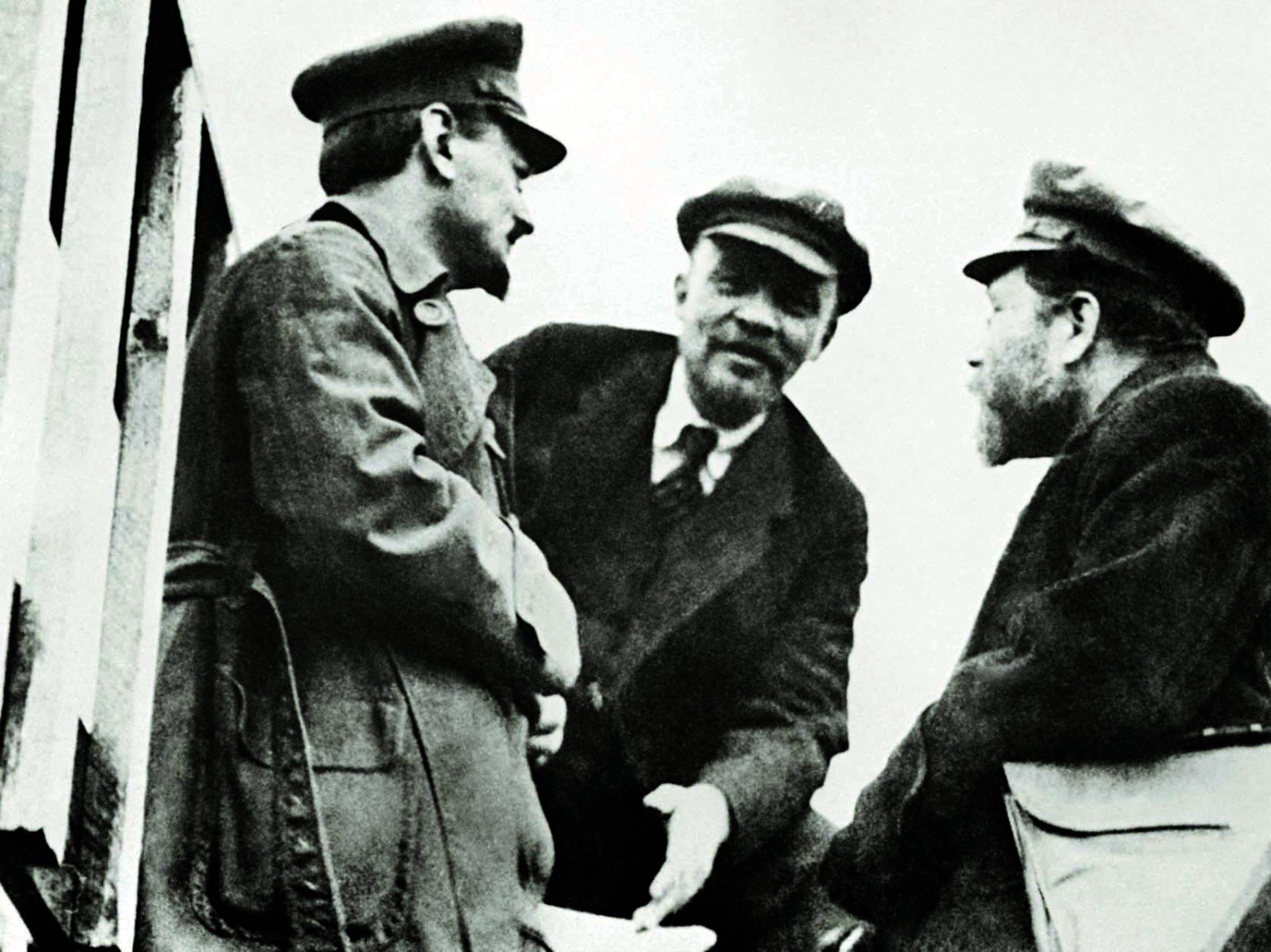
Leon Trotsky, Vladimir Lenin, and Lev Kamenev (left to right). Moscow, May 1919
by Angus McFarland
Maine
2024 marks the 100th anniversary of the death of Lenin (Vladimir Ilyich Ulyanov). Along with Leon Trotsky and the Bolshevik party, Lenin (1870–1924) led the socialist October Revolution that “shook the world” in 1917. Class conscious working-class people are increasingly looking to Lenin’s life and ideas to help find a solution to a capitalist world of wars, oppression, alienation, and inequality.
Lenin helped develop the revolutionary methods that led the working class and poor peasants to victory over the brutal regime of Czar Nicolas II, ended the Russian Empire’s involvement in the disastrous First World War, and created the world’s first worker’s government–in its first years the most democratic form of government in history. We study the life and thought of Lenin not out of hero worship or devotion to a cult of personality, but because the revolutionary methods that he developed are still relevant in the struggle to transform our modern society.
He was born on April 9, 1870 in the town of Simbirsk, now Ulyanovsk. His eldest brother Aleksandr joined the “People’s Will” movement and took part in the unsuccessful attempt on the life of Alexander III. He was executed at the age of 22. This event had a strong influence on Lenin’s later life and thought.
In the summer of 1887 Lenin entered the Kazan University to study law, where he first met members of the local Marxist circle. In 1894 he moved to St. Petersburg, where he made connections with workers and spread socialist ideas. There followed a period of organizing, writing, imprisonment, and exile to Geneva in 1900, until the Revolution of 1905 brought him back to Russia.
Although it was crushed, the Revolution of 1905 taught Lenin vital lessons, informing his understanding of the state and socialist revolution for 1917. He noted how workers overcame the laws and police of the Russian state, at least for a time, by building new bodies of power through councils (or soviets) of workers, peasants, and soldiers. The use of force by the state to crush the 1905 revolution pointed to the need for workers to defend themselves and establish a workers’ government to hold onto power.
From 1907, Lenin would be exiled for 10 years, but never ceased working towards revolution. In an endless stream of letters and articles he strove to keep the Bolsheviks on a realistic and thoroughly Marxist track, arguing against all kinds of distortions of doctrine and unsound methods.
At the outbreak of the February Revolution of 1917, Lenin was in Switzerland. He hurried back to Russia, arriving in Petrograd on April 4. At this time he developed the April Theses, a set of ten statements that laid out a radical program for the Bolshevik Party. He insisted, among other things, that the revolution must go beyond the provisional (capitalist) government to create a socialist state under democratic control of the soviets. Trotsky returned from exile in May, and joined the Bolsheviks, supporting Lenin in fighting for the socialist cause.
The more radical program laid out in the April Theses, in contrast to the ineffective and untrustworthy Provisional Government, caused the Bolshevik party to grow in popularity, and demonstrations by soldiers, sailors, and factory workers took on a new energy. The crackdown that followed forced Lenin to flee to Finland, where he continued to agitate via letters and articles for the soviets to take power. In October, he returned to Russia again to see the supreme power pass into the hands of the soviets, and the proletarian revolution began in earnest.
As the work of creating the first workers’ state the world had ever seen progressed, Lenin’s health worsened. Though the cause of his illness is not known, he suffered several strokes that took his mobility, then his speech, and finally his life. He worked as long as his body would allow, trying to guide the new Soviet state towards socialism and democracy, but he lived to see the beginnings of the bureaucratization that would eventually cause the Soviet Union to degenerate under Joseph Stalin. Trying to forestall this, he wrote a testament that recommended replacing Stalin as General Secretary of the Communist Party, but unfortunately Stalin had already consolidated power and this was not done.
Lenin should be remembered as a brilliant Marxist theoretician, a tireless revolutionary, and a natural leader. His writings, even after a hundred years, cut clean and clear “to the root of the matter,” which Marx said is the essence of radical thought.
 Independent Socialist Group