
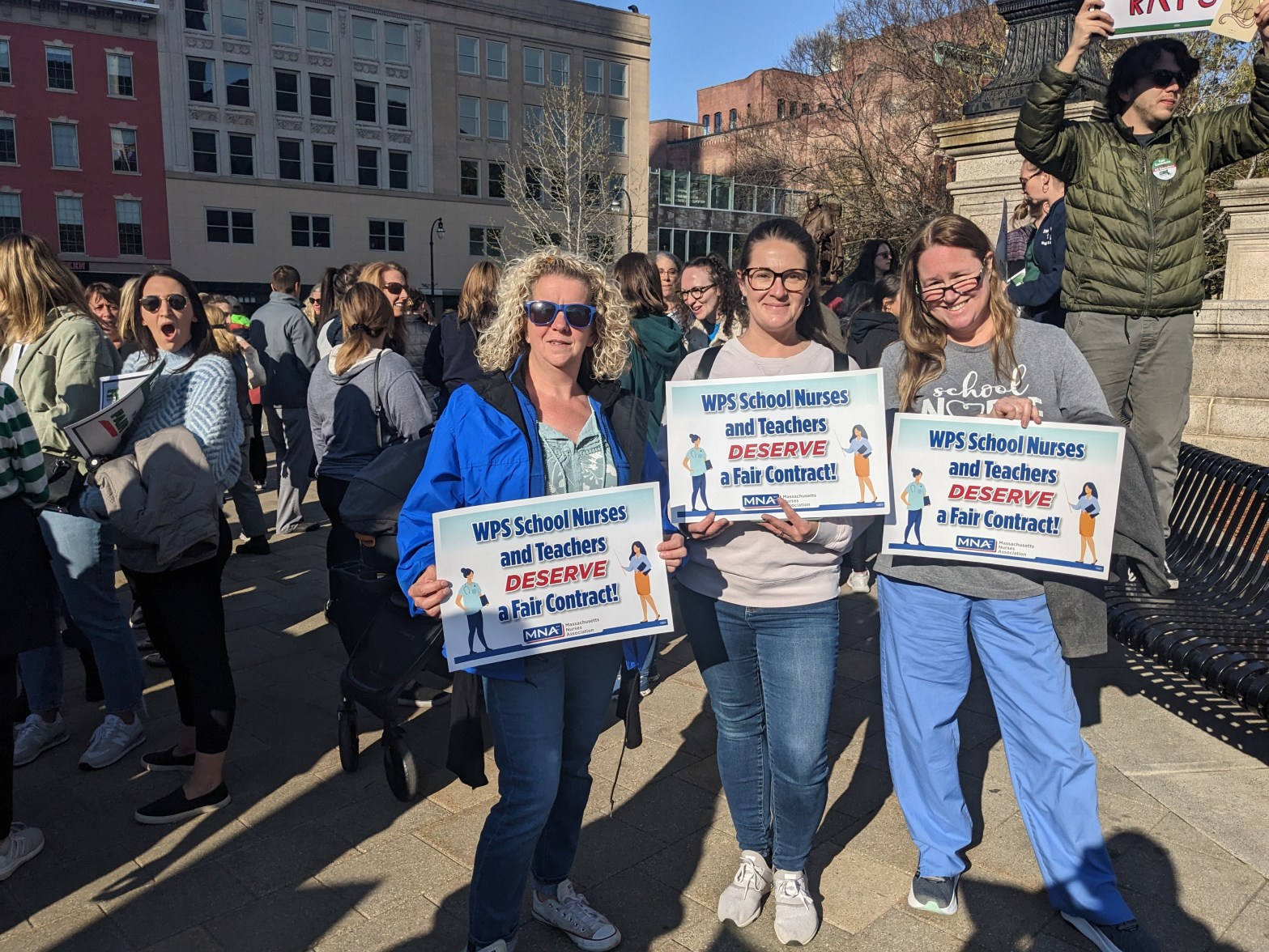
Union educators & nurses rally together in Worcester, MA.
by ISG members in the Massachusetts Teachers Association (MTA)
In April, ISG members in the Massachusetts Teachers Association (MTA) participated in the union’s Annual Meeting of Delegates. This is the union’s highest decision-making body, with elected delegates – representing 117,000+ educators in pre-K through higher ed – voting on MTA leadership, setting the annual budget, and deciding the union’s priorities by discussing and voting on resolutions to adopt. Many discussions centered on issues educators face both inside and outside our workplaces.
The year’s meeting debated whether the union should take a public stance on opposing Israel’s genocidal policies in Gaza. Last fall, the MTA stated its support for a ceasefire, joining many other unions in the National Labor Network for Ceasefire. ISG educators submitted a resolution for the MTA to stop US military aid to Israel, to publicly support the student encampments, and to condemn the arrests on campuses. We called for the union to encourage members to attend protests as MTA members.
Our other resolutions this year aimed to prepare our union to fight against ongoing statewide staffing and budget cuts and to win improved pay, staffing, and programs. These included proposals for an MTA strike fund, a cross-local solidarity network, and an end to financial support and endorsements of the two corporate parties.
Nationwide, educators are facing layoffs despite chronic understaffing in many districts. Democratic and Republican politicians alike claim that the end of federal funding from the Covid-19 Elementary and Secondary School Emergency Relief Fund created deficits in school budgets, yet large sums of cash are available to prevent these cuts. Massachusetts has a growing $8.2 billion state Rainy Day Fund that generates $250M in interest annually. It also has an additional revenue stream earmarked for education and transportation from the 2022 “Fair Share” ballot referendum that won a 4% surtax on annual income above $1M. It’s on track to bring in almost $4B this year. Many localities also have increased “Free Cash” funds. In 2021, “Free Cash” statewide totaled $900M; in 2023, it reached over $1.4B.
Educators are fighting cuts by organizing rallies and protests with community supporters and packing city and town hall meetings. But no local should fight alone, educators should join together statewide when protesting or going on strike. Our resolution for regional and statewide solidarity networks between MTA locals calls for coordinated cross-local actions. Our resolution for an MTA strike fund can empower locals to take strike action and help pay any incurred fines. Ultimately, school budget deficits, cuts, and fines against educators in “blue” Massachusetts are evidence that the Democratic Party is not an ally to workers. ISG’s final resolution raised the need for the MTA to end its endorsement of and financial support for both corporate parties and to only support independent pro-labor candidates. MTA-endorsed Democratic Party governor Maura Healey firmly supports the ban on public-sector strikes. Last year, Healey and both the Democratic and Republican parties passed $400M in tax breaks for the rich, then proposed cutting Medicare by $294 million in January. The Democratic Party punished locals for striking, hitting Newton educators with $650,000 in fines for its fight against proposed 1-2% cost-of-living increases and a $27,000 starting wage for paraprofessionals.
ISG members advocate for the MTA to only support politically-independent pro-labor candidates, free from corporate funding or influence. Our union should also help to build the foundation of a workers’ party that can run candidates, potentially union members, who can build a broader movement to fight staffing and budget cuts, increase taxes on the rich and large corporations, and improve education and other public services for all our communities.
 Independent Socialist Group