
by Ben Desjarlais & Jacob Bielski
Springfield, MA
Organize Protests to Pick Up Where the Campus Encampments Left Off!
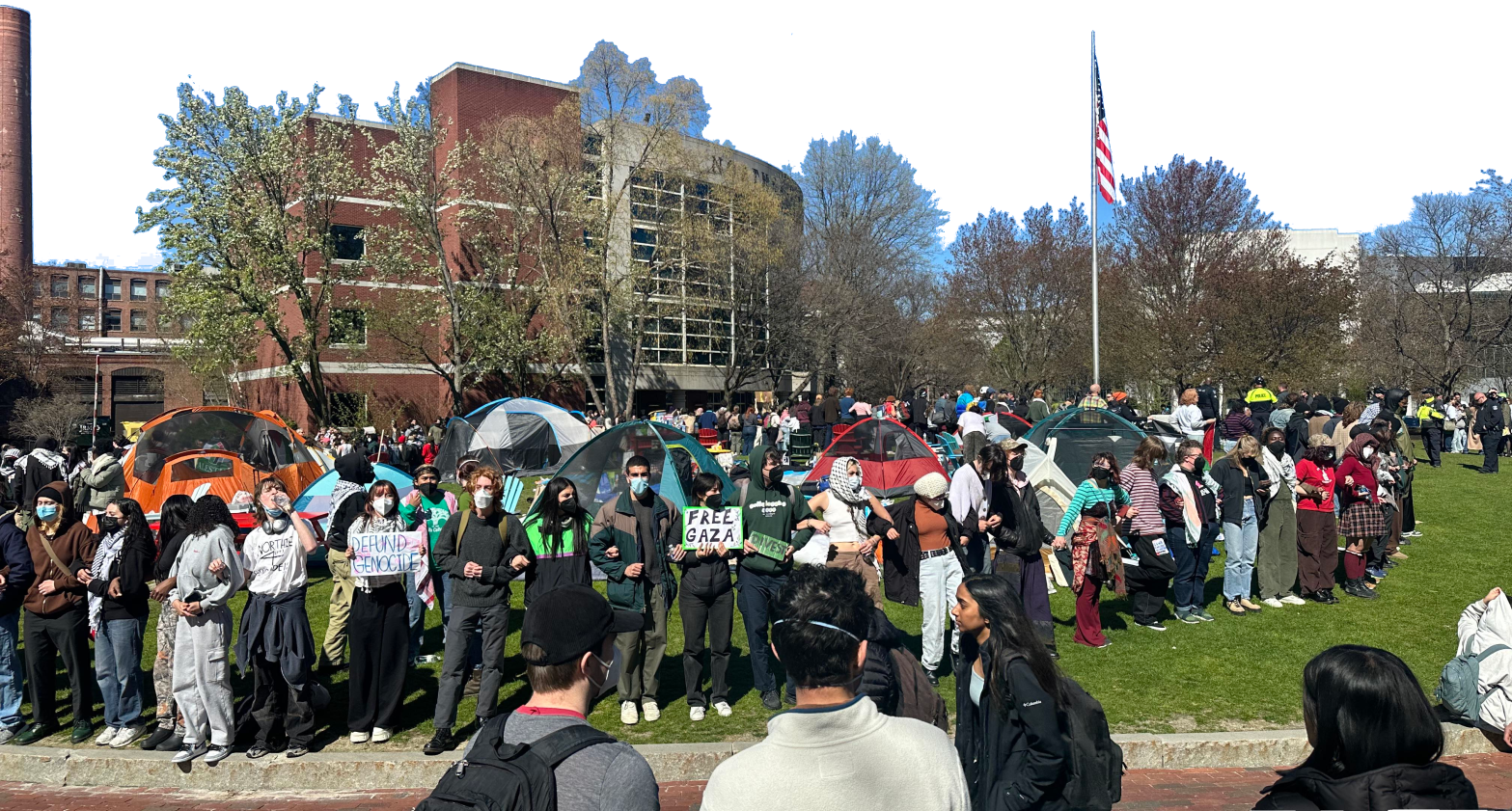
On April 17, hundreds of Columbia University students started a Gaza solidarity encampment after efforts to force divestment were answered by a crackdown on pro-Palestinian activity across the campus. University president Minouche Shafik called in New York City police to destroy the assembly, resulting in over 100 arrests.
Students, undeterred, came back and continued protesting, sparking solidarity actions at 100+ campuses across 30+ states. From Harvard University to Florida State University, from the University of Texas to universities in Argentina, France, and Australia, tens of thousands of students organized against Israel’s ongoing genocide in Palestine.
Students used tactics including occupying buildings, setting up outdoor encampments, and organizing mass protests and rallies. University administration and local corporate politicians called out campus, local, and state police to violently attack the peaceful protests, carrying out arrests of thousands of activists. The courts charged many protestors, and the university administrations expelled, suspended, fired, and otherwise threatened students, faculty, and workers. It was the largest escalation of the protests against Israel’s genocidal war on Gaza, and the ruling class was intent on shutting it down.
As the school year wrapped up, some universities negotiated the end of encampments with students. In some cases, students organized walkouts at commencements. While protestors won some concessions, the New York TImes quoted Angus Johnson, a historian of student activism, wrote “many of the agreements felt like ‘kicking the can down the road,’ buying time without solving much.”
What did the encampments win?
Overwhelmingly, universities rejected the protests’ main demands for disclosure of and divestment from financial and military research ties to Israel. Evergreen State was the only college to promise some degree of divestment. Protestors at Brown University won promises of disclosure of investments and that the Board of Trustees will vote on divestment at a later date.
From there, pledges to disclose and divest get vaguer, often reduced to assurances of discussions between students and boards of trustees. Wealthy donors are withholding money to pressure administrations to continue refusing student demands. NYC mayor Eric Adams met with major business interests who offered money and even private investigators and detectives for Adams to use against the protestors. Universities are hoping energy around the protests will die out so they won’t need to take further action in the coming school year.
Off-campus, the protests won a pause on one shipment of offensive military aid to Israel in May. However, less than a month later, the Biden administration approved a $1 billion arms transfer to Israel. Building the movement through the summer is necessary to win more than promises.
False Anti-semitism Charges Used to Violently Break Up Encampments
Many universities resorted to violent suppression of protests, even before considering negotiations. In Boston, MA, police attacked the Emerson University encampment so brutally that the protestors’ blood needed to be cleaned away with pressure washers the next day. The Emerson student government responded with a vote of no confidence against the university president.
Northeastern University justified arresting protestors on April 28th by saying the protestors were chanting “kill the Jews.” Jewish student organizers and professors at Northeastern showed it was chanted by pro-Israel counter-protestors that tried to goad the encampment into responding with anti-semitism. The anti-war organizers chanted back “do not engage.” Students complied with arrests to avoid additional charges and the brutality faced by Emerson students, but while community members rallied to temporarily block the police vans in solidarity and show support for the protestors. Between the two campuses, over 200 protestors were arrested.
At the University of California, Los Angeles, the university administration declared the gathering illegal and authorized the LAPD, LASD, Highway Patrol, and university police to move in on the encampment. Before the hundreds of officers could brutalize more students, right-wing and pro-Israel instigators attacked the encampment with tear gas, fireworks, and baseball bats. Ironically, the pro-Israel groups, motivated to attack the encampment by portrayals of the protestors as anti-semitic, fought alongside neo-Nazis. While these forces beat and bloodied encampment protesters and terrorized the campus, police sat back and watched their jobs being done for them. Encampment protestors could not rely on police, and chants of “we keep us safe” lasted through the night’s attack.
It is not anti-semitic to criticize Zionism, oppose the Israeli state’s occupation and invasion of the Palestinian territories and call for disclosure, divestment, and an end to military aid. The encampments overwhelmingly rejected calls for violence or discrimination against the Jewish people. Rather than actually fighting anti-semitism, the escalatory repression and corporate media’s portrayal of the protests inflamed religious and ethnic tensions on campuses.
Turning Up the Heat
While the student encampments and occupations were a step in the right direction, the movement needs to go further by involving workers, nationally coordinating actions, and building long-term organizations that allow students, staff, and communities to democratically discuss and decide on the best way forward.
The presence and support of unionized faculty, staff, and graduate students–who joined protests, built their own encampments, and organized walkouts–was an important development. But union workers outside of higher education should unite to defend protesters and escalate the movement.
The UAW, which represents many grad workers, was the first major union to call for a ceasefire. It joined with what is now over 200 national and local unions representing 9 million workers in the National Labor Network for Ceasefire. In mid-May, UAW Local 4811, which covers 48,000 University of California grad workers, went on strike in defense of its members and the student protests. UAW president Shawn Fain has condemned the college arrests and crackdowns. In Canada, the president of the Ontario Federation of Labor (OFL) called for union members to join a solidarity rally, stating that if the University of Toronto wanted to attack students, “you’ll have to go through the workers first”. Other unions should follow the UAW and OFL, go beyond petitions and statements, and bring their demand for a ceasefire into the streets.
In past anti-war movements, workers refused to build or ship arms. For example, from 1974-1978, Scottish workers refused to work on parts for the fighter jets of the Pinochet dictatorship in Chile. Unions with members in the military industry, including the UAW, could directly withhold their labor and put far greater pressure on the capitalist class to end their funding and armament of the genocide.
However, the UAW and other unions have endorsed Biden and other Democrats in the upcoming November elections. Both the Democratic and Republican parties have readily funded the Israeli military–$200+ billion over the last 80 years–and sent in city police and state troopers against protestors. It’s crucial for youth, students, and working-class people to go beyond chanting “Genocide Joe!” or voting “uncommitted”. We need to build a workers’ party to challenge the two capitalist, imperialist parties. A workers’ party can contest elections and help build a movement to defend our right to protest and campaign for a foreign policy of solidarity that supports the right to self-determination.Palestinians in Gaza can defend themselves through democratic, working-class organizations. In the West Bank a mass movement along the lines of the First Intifada can be organized. In Israel, ongoing mass anti-war protests have the potential to end the war. Only a year ago, the Israeli working class organized a general strike against the Netanyahu government. Workers and youth across the Middle East must build independent political organizations to oppose the war, religious extremism, and the far right. A mass, democratic, and socialist struggle can win safe homes, secure jobs, and self-determination–things the capitalist system can’t provide. A socialist federation of the Middle East can guarantee economic and democratic rights for all. By uniting workers against imperialism, genocide, and war through an international socialist movement, we can achieve peace and national liberation.
 Independent Socialist Group