
by Miranda Alpert
Sharon Teachers Association / Massachusetts Teachers Association (personal capacity)
Boston, MA
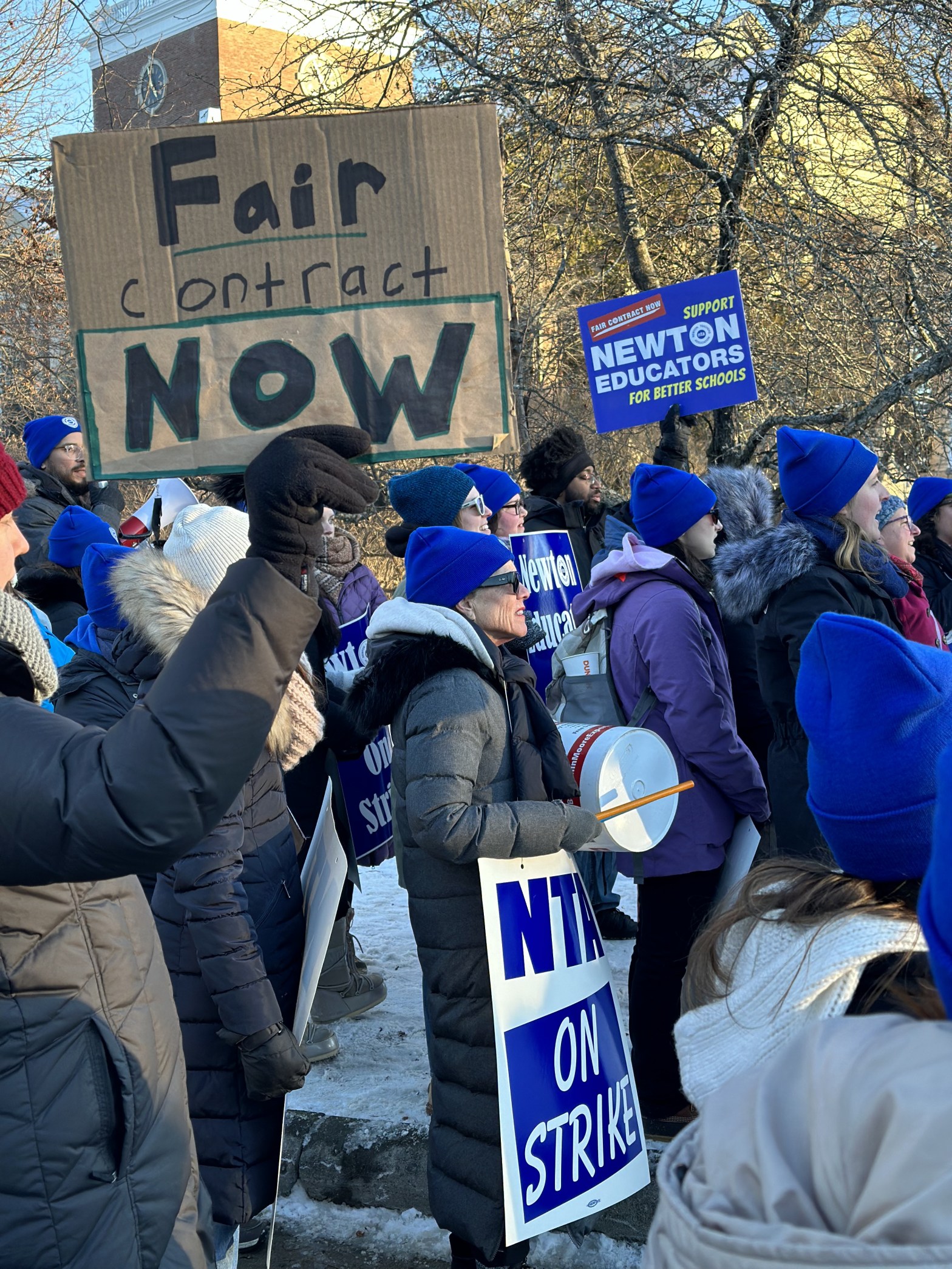
There has been a recent wave of strikes by members of the Massachusetts Teachers Association (MTA), part of the National Education Association (NEA). Although public-sector strikes are illegal in 37 states, including Massachusetts, educators in Brookline, Malden, and Haverhill in 2022, as well as Woburn and Andover in 2023 and Newton in 2024, have struck for strong contracts with pay raises for paraprofessionals, better working conditions, and increased funding for public education.
While these strikes won significant gains, state courts imposed heavy fines on these MTA locals. Massachusetts is virtually a one-party state with a Democratic-Party governor, control of the legislature, and most local city councils and school districts. Governor Maura Healey publicly criticized teachers’ strikes and gave her enthusiastic support for maintaining the ban on public sector strikes. Local school districts controlled by Democratic officeholders are forcing through budget cuts and layoffs. For example, in Braintree, approximately 100 educators are being laid off, up to two elementary schools may be closed, courses eliminated, and bus and extracurricular fees raised.
These cuts are being made despite plenty of money, including a “quickly growing” $8.2 billion state Rainy Day Fund, which generates $250 million in interest annually. There’s also a new revenue stream earmarked for education and transportation from the 2022 “Fair Share” ballot referendum initiated by the MTA which won a 4% surtax on annual income above $1 million.
Winning the legal right to strike
The AFL-CIO and other unions must build unity between public and private sector unions to organize labor-community campaigns for public sector workers’ right to strike, using union resources for media, public meetings, and rallies to build mass support. Unions need to coordinate strike action, organizing for general strikes in key cities to exert real pressure to win the right to strike for public sector workers. The labor movement in Massachusetts and other states should connect expanding the right to strike to using political strike action to add power to social movements for living wages and increased funding for education, housing, transportation, healthcare, and other social benefits.
Break with the Democrats and help build an independent workers’ party!
The Democratic and Republican parties are responsible for attacks on unions’ right to strike, including public sector and transportation workers. Workers need our own political party, independent of the two corporate parties and funded by unions and working people to fight for union rights and fully-funded social services. Unions can’t avoid politics. The choice is whether we continue to support and vote for what the corporations want or use our power as workers for mass union organizing, strikes, and independent political action to win the battles ahead. The MTA and the NEA have the potential to be part of creating a workers’ party and run labor candidates for public office to promote union rights, including the unrestricted right to strike.
 Independent Socialist Group